In April 2013, Peter and I spent a month in Aix-en-Provence. We enrolled in a French immersion program affiliated with the IS Aix-en-Provence International Language Institute which provided French lessons four half-days a week and an introduction to French culture. We rented an apartment for four weeks at the Adagio Aparthotel in Aix's Old Town, just a short stroll from the famed Cours Mirabeau and within walking distance to our school. It was a good time for me to take off from work and I could easily keep in touch with my laptop and the internet.
On the weekends we went on excursions to some of the hill towns of the Luberon — Isle-sur-la-Sorgue, Roussillon, and Gordes — along with day trips to Arles, Avignon, and Marseille. We also visited the famous wine region of Chateauneuf-du-Pape and the coastal town of Cassis. Because we had previously taken a road trip through the Rhone Valley and Provence, we were familiar with this area of France. However, we had never made it to Aix or Marseille — two cities that we had always wanted to visit.
Vineyards in the Luberon Valley
About Aix-en-Provence
Aix-en-Provence was built by the Romans because of its strategic location and thermal springs. Water has been integral to Aix's identity ever since and there are fountains everywhere. During the 12th century, Aix became the capital of Provence; the city is also the site of one of the oldest universities in France.
The Cours Mirabeau boulevard is known for its canopy of plane trees flanked on either side by elegant mansions with wrought iron balconies and sculpted facades from the 17th and 18th centuries. Other notable buildings in Aix include the Cathedrale Saint-Sauveur d'Aix-en-Provence, the Place de l'Hotel de Ville, and Paul Cezanne's home — born in Aix, the artist returned to the city later in life to established his studio.
Looking down the Cours Mirabeau with a landmark fountain
Place de la Rotonde at the western end of the Cours Mirabeau
Daily Life in Aix
We arrived in Aix at the beginning of April when the plane trees were just starting to leaf out. By the end of the month the foliage was verdant and the wisteria vines were in bloom. Although there were a few rainy days, the weather was sunny and pleasant most of the time, particularly during our visits to cities and villages outside of town.
Plane trees starting to leaf out
Wisteria in bloom by our school
Other budding foliage
The Adagio Aparthotel — an apartment that rents by the week with some of the amenities of a hotel — was in a good location and our apartment had a balcony overlooking a lovely courtyard. We had a kitchenette and there was a large supermarket a few blocks away. We also had weekly housekeeping service and access to laundry facilities.
Our apartment and balcony
A lovely view from our balcony
Aix-en-Provence is a great walking city with pedestrian-friendly thoroughfares, parks, gardens, and many outdoor cafes. Aix also has two weekly outdoor markets with vendors selling fresh produce, souvenirs, antiques, and various other items.
Lots of outdoor cafes
The Place de l'Hotel de Ville is the city center
A wedding party in front of City Hall at the Place de l'Hotel de Ville
Enjoying a coffee before class
The school was a pleasant 30 minute walk through Aix's narrow streets to the other side of town, just across the ring road that circles the city. Our classes rotated from morning to afternoon week-to-week and we typically met other students for dinner at a local restaurant on Fridays as well as for lunch or dinner several other times during the week. When we had morning classes, we would often stop at a cafe close to the school for a coffee and croissant before class.
Starting my walk to class
Walking down a narrow side street
Crossing a square
The bakery where we frequently stopped for a coffee and croissant before class
Entrance to the IS International Language Institute
Looking back towards town after crossing the ring road
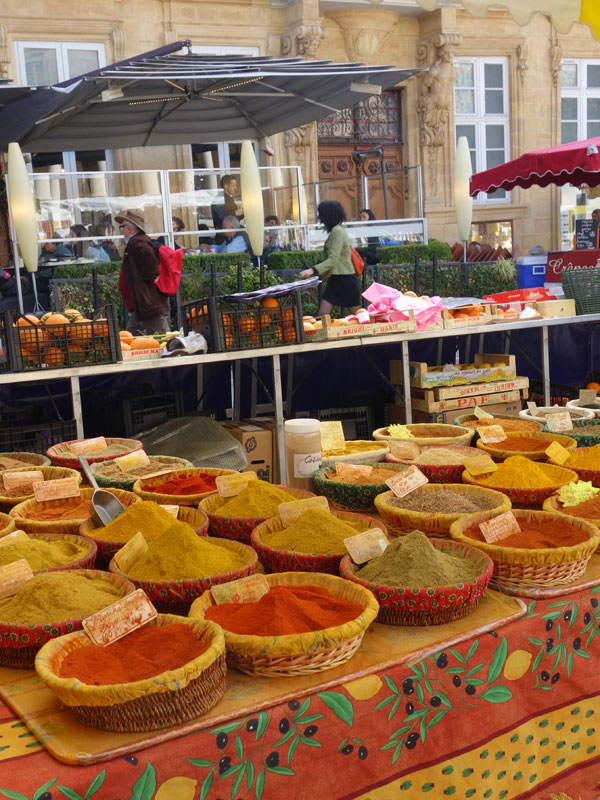
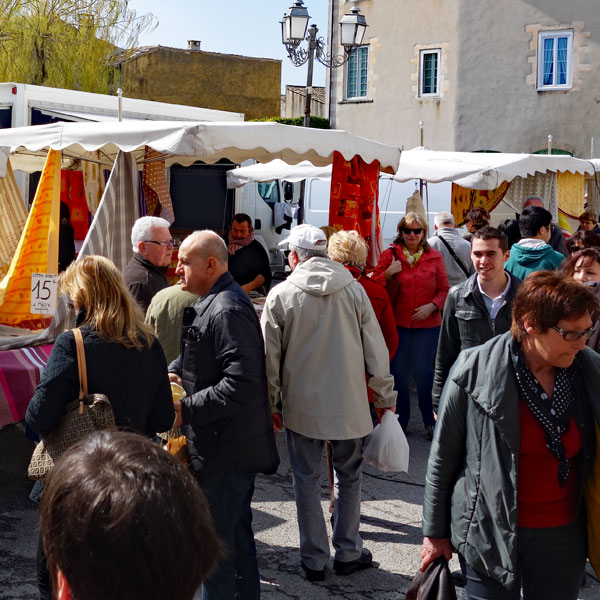
Outdoor street markets are a big part of life in Aix. Locals arrive daily to purchase produce from farmers and mingle with neighbors. The vendors are generally set up by 8 a.m. and disassemble their stands by the early afternoon. In addition to a daily farmers' market, Aix's specialty markets take place on Tuesday, Thursday, and Saturday. For example, there were terrific food markets at the Place des Precheurs and Place de la Madeleine while sunflowers, roses and potted olive trees filled the flower market at Place de l'Hotel de Ville. There were also several antique and flea markets.
Peter at the weekly flower market at the Place de l'Hotel de Ville.
Me at the flower market
Vendors selling spices
Weekly antique market on the Cours Mirabeau
The bakery where we frequently stopped for coffee and a croissant before class
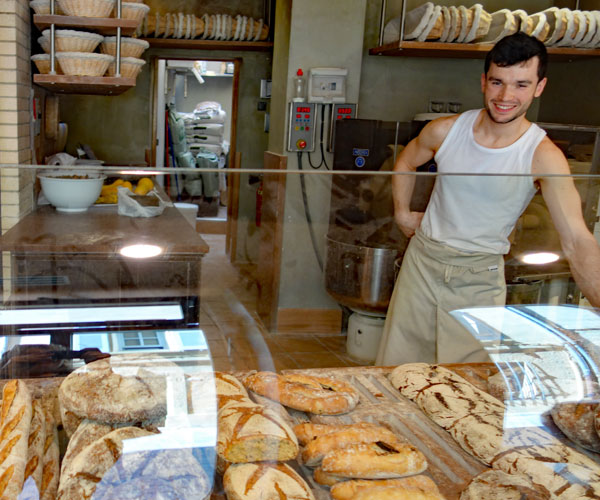
An artisan baker at the Place de l'Hotel de Ville
Traditional carousel. Near the Place de la Rotonde, Aix had a beautiful carousel in operation. We loved to watch the delighted children and hovering parents while it was going around.
Children riding the carousel in Aix
Lots of fun rides for the children
Another view of the carousel
Museums in Aix
Vasarely painting
Aix-en-Provence has several renowned museums. Although the Granet Museum is the city's main art gallery — with ten paintings by Paul Cezanne at the time — it was unfortunately closed for renovation during our month stay. We did, however, visit the Vasarely Museum, the Museum of the Pavillon Vendome, and the Museum of Tapestries on the first floor of the Archbishop's Palace.
Museum of the Vasarely Foundation
Me taking a break at the Vasarely Museum and two other large canvas panels
The Pavillon Vendome — built in the 17th century by the Duke of Vendome
The Gardens at the Pavillon Vendome
Hiking in the Luberon Valley
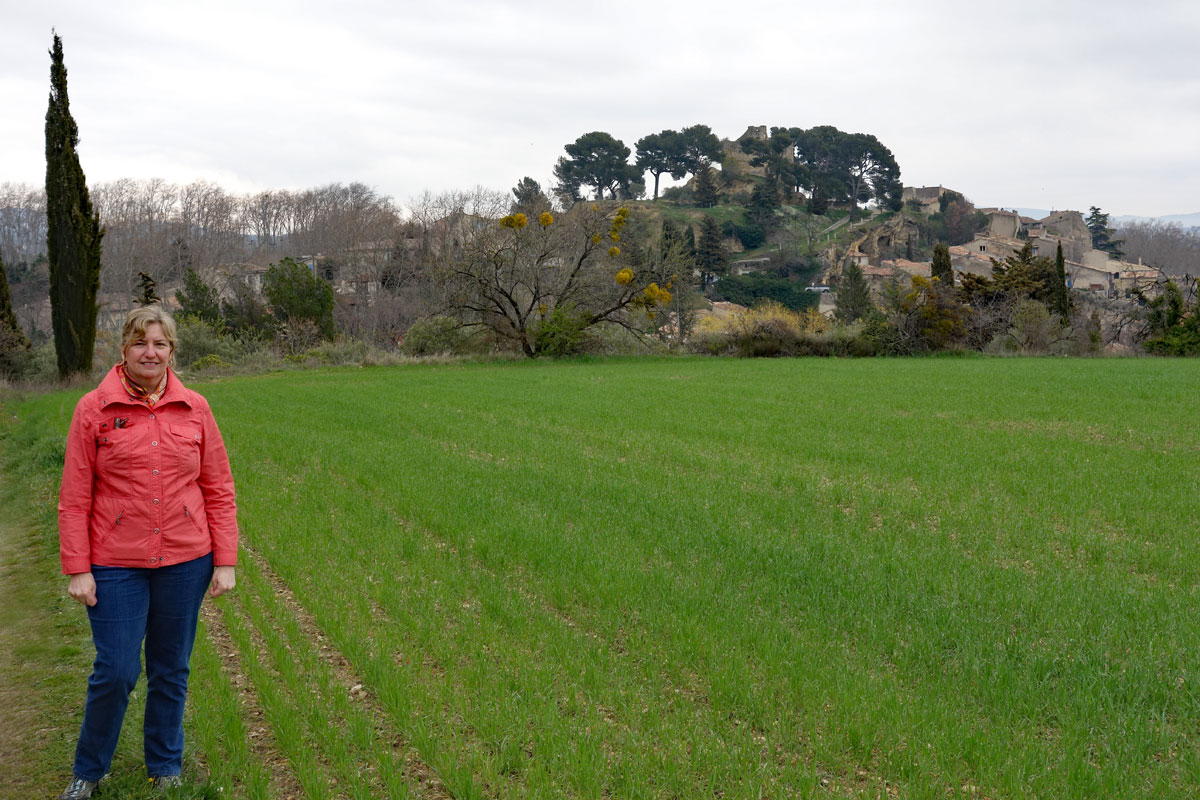
During our stay, we went on several hikes outside the city — walking through a landscape of cypress trees, vineyards, and lavender fields that inspired Matisse, Renoir, and Van Gogh. The Luberon Valley is just north of Aix and Mont Sainte-Victoire to the east — which inspired Cézanne — is the major landmark of the area.
Landscape in the Luberon Valley
Hiking past Saint-Barthelemy Church in Vaugines
Passing by an ancient cemetery
The landscape of the Luberon Valley in April
View of the village of Cucuron in the Luberon Valley
Encountering horses on our hike.
Peter ready for rain
A view of Montagne Saint-Victoire during a hike
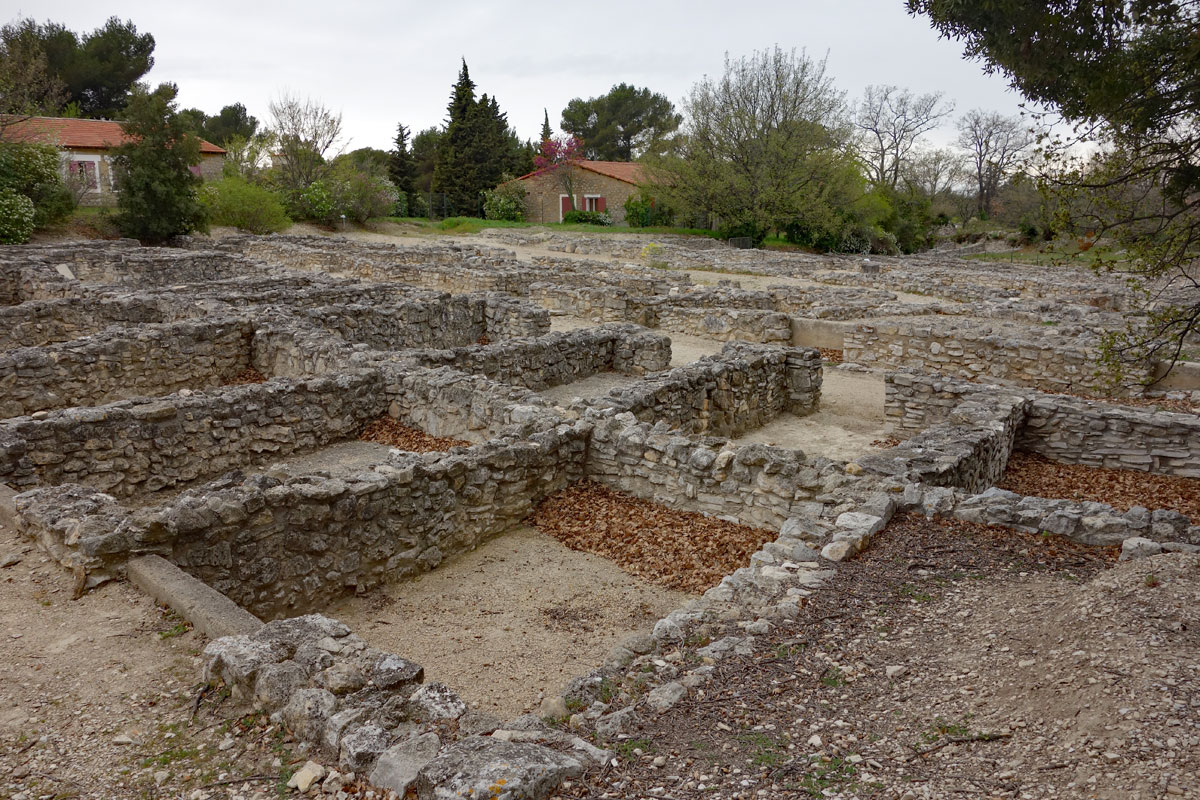
On one of our hikes, we visited the Oppidum d'Entremont which is an 8.6-acre archaeological site just outside Aix-en-Provence. This was the capital of the Celtic-Ligurian confederation of Salyes which was settled between 180 and 170 BC. The site was abandoned when it was taken by the Romans in 123 BC and replaced by the present-day Aix-en-Provence. The site contains two distinct areas of settlement surrounded by ramparts.
Hiking to an ancient Celtic-Ligurian settlement
Meeting with our guide at the ruins
Our guide showing us some ancient pottery
Visiting Arles and the Hill Towns in the Luberon
We spent the Sunday our first weekend visiting the city of Arles and several villages of the Luberon — driving through lavender fields and vineyards set against a stunning mountain backdrop.
Lion sculpture inside Arles City Hall
Arles. Situated on the Rhone River and once a provincial capital of ancient Rome, the city of Arles is known for its Roman ruins including the Arenes d'Arles. This large amphitheater was built in 90 AD and held over 20,000 spectators of chariot races and bloody hand-to-hand battles. It is one of the best-preserved ancient amphitheaters in Europe — resisting wars, epidemics, and the temptation to be used as a stone quarry — and continues to host cultural and sporting events. Arles is also known for inspiring the paintings of Van Gogh.
Daily life in Arles with colorful building facades
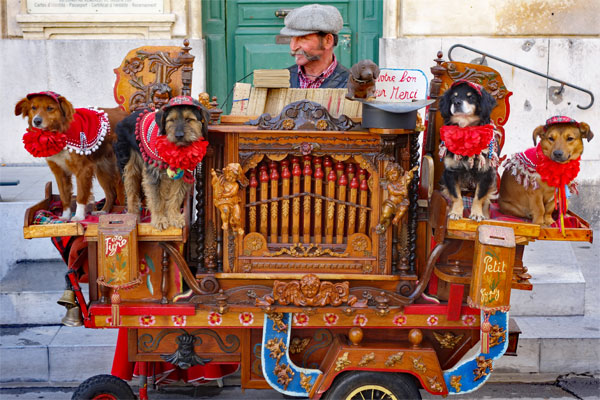
A street organ grinder in the Place de la Republique
We set out on a walking tour through Arles' winding cobblestone streets, populated by impressive monuments and ancient houses adorned with colorful shutters. We then went inside the colossal Arenes d'Arles led by an excellent tour guide.
Exhibit illustrating the layout of the amphitheater
Our guide in Arles
The street encircling the amphitheater
Entering the amphitheater
Impressive structure
Inside the Arenes d'Arles — not many tourists in April
We continued our walk past the Romanesque Cathedral of St. Trophime and the Cafe Van Gogh which was the inspiration for his iconic “Cafe Terrace at Night” and other paintings. We also visited the Hotel-Dieu Hospital where Van Gogh was hospitalized several times. The the former hospital building and gardens is now known as Espace Van Gogh and used for cultural events.
Two remaining columns of the Arles Roman Theater
Entrance to the Cathedral of St. Trophime
The entrance stairs inside the Arles City Hall
The cafe that inspired several Van Gogh paintings
The Hotel-Dieu where Van Gogh was hospitalized several times
Before we left Arles, we had lunch at the Bistro A Cote. We were greeted by its owner and Chef Jean-Luc Rabanel who was the first Michelin Star chef to open a restaurant where the produce was grown in its own organic vegetable garden. We had a wonderful prix-fixe lunch with several courses.
Posing with the Chef Jean-Luc Rabanel
A beautiful presentation
Home made bread ready for slicing
Hill towns of the Luberon. After lunch, we drove to the charming village of Isle-sur-la-Sorgue which is also known as the “Venice of Provence.” The town gets its name from the Sorgue River which flows through and around this charming town. It is also famous for its antique market and known as the birthplace of Cubism.
View of Isle-sur-la-Sorgue along the Sorgue River
One of the Sorgue River dams
Posing along the river front
The crowded Sunday antique market
Lots of vendors selling unusual antiques and collectables
Peter posing with a propeller for sale
We continued to the red-ochre village of Roussillon with its russet, gold, and orange buildings. Then we went to the nearby hill town of Gordes, perched above olive terraces, which had magnificent views across the valley. We had visited both of these villages in 1997 and, as with most of the hill towns of Provence, nothing had really changed. Later, we explored the gardens and vineyards of the impressive Renaissance Chateau Val Joanis and had a hearty dinner with local ingredients.
View of the Luberon Valley near Roussillon
Typical golden building facade in Rousillon
The red-ochre cliffs of Rousillon
View of the hill town of Gordes — where we had stayed for several days in 1997
The last hill town that we visited was Les Baux with its steep cobblestone streets. We were particularly impressed with the humble Saint-Vincent Chapel — a 12th century building that is typical of the construction in Les Baux with its southern section built half into the rock.
Typical street in the hill town of Les Baux
Entrance to the Saint-Vincent Chapel in Les Baux
Inside the Saint-Vincent Chapel
Roman ruins. We also visited several Roman ruins along the way. Our first stop was to view the Pont Julien between Rousillon and Bonnieux. This stone bridge over the Calavon River dates from 3 BC. We then stopped to see the Triumphal Arch of Glanum and adjacent mausoleum which were built in the 1st century.
Pont Julien — a Roman stone bridge dated from 3 BC
Triumphal Arch of Glanum built in the 1st century near Saint-Remy-de-Provence
Detailed stone carving from the Mausoleum at Glanum
Avignon and Chateauneuf du-Pape
On our next weekend, we spent a day exploring Avignon and Chateauneuf-du-Pape in the heart of the Vaucluse. Situated on the banks of the Rhone River, Avignon is known as the seat of the papacy in the 14th century. As a result, it evolved into a lively hub of arts and learning.
View of the Palais des Papes in Avignon
Avignon. After arriving in Avignon, we first visited the Palais des Papes which is one of the largest and most important medieval Gothic buildings in Europe. Once a fortress and palace with ramparts, towers, and turrets, the papal residence was a seat of Western Christianity during the 14th century. Afterwards, we ate lunch in the beautifully preserved medieval town center.
Street scene outside of the Palais des Papes in Avignon
A scale model of the Palais des Papes on display
Taking a break on my tour of the Palais
Statues on display at the Palais
View of the golden statue of the Virgin Mary atop the Cathedrale des Doms just next to the palace
One of the several imposing medieval entrance doors at the the Palais des Papes
The interesting arches along one of the corridors in the Palais des Papes
Ceiling murals at the Palais des Papes
Posing in front of the Pont Saint-Benezet
The Pont Saint-Benezet — known as simply the Avignon Bridge — is another famous landmark in Avignon. An older wooden bridge was rebuilt beginning in 1234 with 22 stone arches. The stone bridge was about 980 yards in length and only 16 feet in width, including the parapets at the sides. However, it was abandoned in the mid-17th century as the arches tended to collapse each time the Rhone River flooded, making it very expensive to maintain. Four arches and the gate house at the Avignon end of the bridge have survived.
View of the famous unfinished Pont Saint-Benezet
Chateauneuf-du-Pape. After Avignon we went to the hilltop village of Chateauneuf-du-Pape where some of France's finest wines are produced. A ruined medieval castle — built in the 14th century for Pope John XXII — sits above the village and dominates the landscape. The centuries-old vineyards were planted by the Avignon popes who were great wine lovers. The Chateauneuf-du-Pape blend includes thirteen varieties of grape, resulting in rich, full-bodied flavors. At the Caveau Domaine Mousset, we tasted some of the wines for which the town is known.
View of one of the many vineyards with the Chateauneuf-du-Pape in the background
Wine tasting at the Caveau Domaine Mousset
Marseille and Cassis
On another day trip, we went to Marseille, a bustling port city overlooking the Mediterranean and France's second-largest city. Afterward, we stopped in the seaside town of Cassis on our way back to Aix.
Marseille. Upon arrival in Marseille, we went up to the basilica of Notre-Dame de la Garde, a neo-Byzantine structure which is located on the highest hill near the Old Port. The current basilica was designed by architect Henry Esperandieu and constructed in a Neo Byzantine style around 1860; it features the typical elements of that style — domes, mosaics, and colorful stonework. The site also provides sweeping views over the city and the Mediterranean.
Notre-Dame de la Garde
Views of the city and the Mediterranean from the Notre-Dame de la Garde
Notre-Dame de la Garde reflects the city's deep-rooted maritime heritage. The walls inside are lined with paintings depicting scenes of perilous sea journeys and there are a variety of ship models suspended from the vaulted ceiling. The basilica is topped by a golden statue of the Virgin Mary and the basilica is known by locals as “La Bonne Mere.”
The Neo Byzantine facade
Beautiful maritime-themed interior with suspended ship models
We then explored the bustling marina of the Old Port where sailboats depart for nearby islands and fishing boats unload their catch — perhaps destined to star in a pot of bouillabaisse. To the north is the oldest district, Le Panier, which was rebuilt after World War II. Marseille is infused with a vibrant, cosmopolitan air and is known as a melting pot of many inhabitants dating back to the ancient Greeks. We saw souk-like African bazaars sharing the streets with Provencal markets in an interesting cultural fusion.
Posing at the Basilica
Walking toward the Old Port
View of the Old Port in Marseille
The sculpture L'Ombriere de Norman Foster at the Old Port
Taking photos of ourselves looking up at the mirrored ceiling of the sculpture
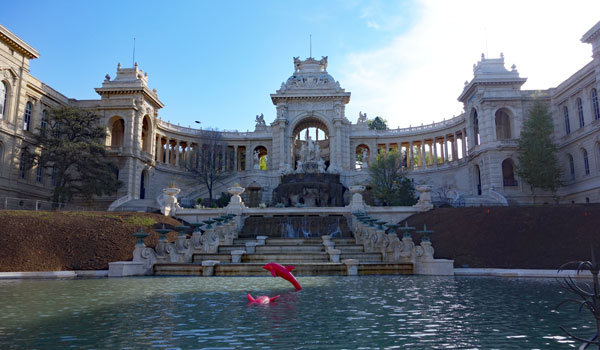
A sculpture by noted architect Norman Foster — titled L'Ombriere de Norman Foster — is one of the tourist attractions at the Old Port. We also visited several other key landmarks in Marseille including The Palais Longchamp and surrounding gardens and the Saint-Charles Train Station. The Palais Lonchamp, completed in 1869, was built to celebrate the bringing of drinking water to the city.
The Palais Longchamp
Looking up the stairs of Saint-Charles Train Station
Facade of the Unite d'Habitation by Le Corbusier
As we departed the city, we visited the Unite d'Habitation — one of Le Corbusier's high-rise concrete residential buildings which was influential in 20th century modernism and contemporary residential design in Europe. The first structure was built in Paris and the second completed in 1952 in Marseille.
Cassis. After lunch we took a scenic drive to Cassis, a small Provencal fishing village on the Mediterranean coast. Peter took a boat cruise through the narrow inlets of the Calanques of Marseille with its unique limestone sea cliffs and turquoise inlets that resemble fjords. I spent the time strolling through town with its quaint shops and cafes.
Cap Canaille near Cassis — the highest sea cliff in France
The stone lighthouse in Cassis — a landmark on the French Mediterranean Coast
The beautiful port at Cassis
Views of the Mediterranean Coast around Cassis
Our Last Week in Aix
During our last week in Aix, our guide for Arles, who has a house n Aix, hosted a reception for us. We also had a celebration dinner with the other French school attendees at one of the restaurants in Aix.
Reception at the house of our Arles guide in Aix
Charlotta — our guide for the month
Enjoying my last meal in Aix
Aix is a particularly beautiful city at night. The Cours Mirabeau and various monuments were all lit up creating a fairy tale like atmosphere.
View of the Place de la Rotonde at night
One of the many cafes on Cours Mirabeau
Statue of King Rene at night
Looking down the Cours Mirabeau in the evening
Postscript. Living in France for a month, we were impressed by several things about the French culture and people. While the farm-to-table movement was just getting started in the U.S., we observed that the restaurants in Provence only served produce that was in season and that most French people do not eat in a restaurant unless they know where the meat was butchered.
We could always tell which restaurants were frequented by local residents versus tourists by just watching if the head waiter greeted the arriving guests with “la bise.” Also, local restaurants do not open for dinner until 7:30 p.m. and customers have their table for the entire evening; it actually takes several tries to get the bill — “L'addition s'il vous plait! ” After our stay in Aix, Peter and I became more discerning about the food we eat and starting cooking at home more frequently instead of dining out.