As an architect, I had always wanted to visit Barcelona. The 19th and early 20th centuries marked Barcelona's golden age of Modernism, a Catalan Art Nouveau movement that sought to revive and celebrate Catalan culture. Antoni Gaudi, the visionary architect, became synonymous with this movement and his iconic works like La Sagrada Familia, Park Guell, and Casa Batllo transformed the city's landscape with organic forms and vibrant colors.
In November 2009, Peter and I spent a week in Barcelona before visiting his mother in Germany. We stayed in the Eixample area which was adjacent to the Old Town and Montjuic Hill and not far from the waterfront — allowing us to walk everywhere.
Flying into Barcelona
Arriving at the Barcelona airport
The lobby of our hotel
The hotel had a nice rooftop pool
Taking a break to read
From our experience, Barcelona is one of the most walkable cities that we have visited. The city is flat with wide sidewalks and very compact given that it has a population of 1.6 million. Many Barcelona streets feature a wide pedestrian area in the central median and the walking areas are tree-lined, and often have benches, vendors, outdoor seating areas, transit stops, and public art.
Barcelona street scene in November
Typical cafe
The famous Boqueria Market
Gaudi's Influence is Everywhere
Barcelona is known for Spain’s most influential architect — Antoni Gaudi — whose influence on Catalan modernism was significant. Having spent most of his life in the city, it has the largest concentration of his works in the world.
About Antoni Gaudi
Gaudí was born in Barcelona in 1852. Ahead of his time, he was a man of faith, observer of nature, and genius architect. His contribution to modern architecture broke all the established rules. With never-before-seen building and structural systems, he created his own unique, unprecedented methodology and a style infused with symbolism. Taking the utmost care in every detail, he also showed his love of artisan trades.
La Sagrada Familia
La Sagrada Familia, or the Basilica and Expiatory Church of the Holy Family, is Gaudi's most important work in Barcelona and is a UNESCO World Heritage Site. It is known for its unique blend of Gothic and Art Nouveau architectural styles and its ongoing construction over the past 140 years. We visited the site on two separate days during our visit since it was conveniently located in the Eixample area where we stayed.
View of the Sagrada Familia towering over the city (Photo from Sagrada Familia website)
View of the four main pinnacles (Photo from Sagrada Familia website)
History of La Sagrada Familia
Construction began on the Sagrada Família in March 1882 under the diocesan architect Francisco de Paula del Villar. In 1883, when Villar resigned, Antoni Gaudi took over as chief architect, transforming the project with his architectural and engineering style, combining Gothic and curvilinear Art Nouveau forms. Gaudi devoted the remainder of his life to the project and he is buried in the church's crypt. At the time of his death in 1926, less than a quarter of the project was complete. Five generations have now watched progress on the Sagrada Familia. Today, more than 140 years after the laying of the cornerstone, construction continues on the Basilica.
The Sagrada Familia's facades feature elaborate sculptures that depict the birth, passion, and death of Jesus, with the Nativity Facade showcasing scenes of the birth and Passion Facade depicting Christ's suffering and death.
The entrance to the cathedral on the Passion Facade
A pensive figure
Barriers
Another sorrowful figure
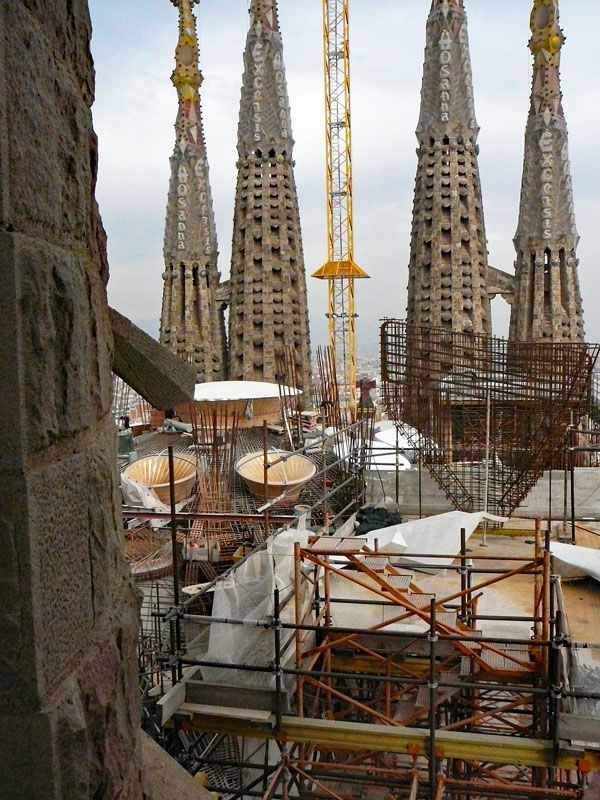
View of the four pinnacles with construction
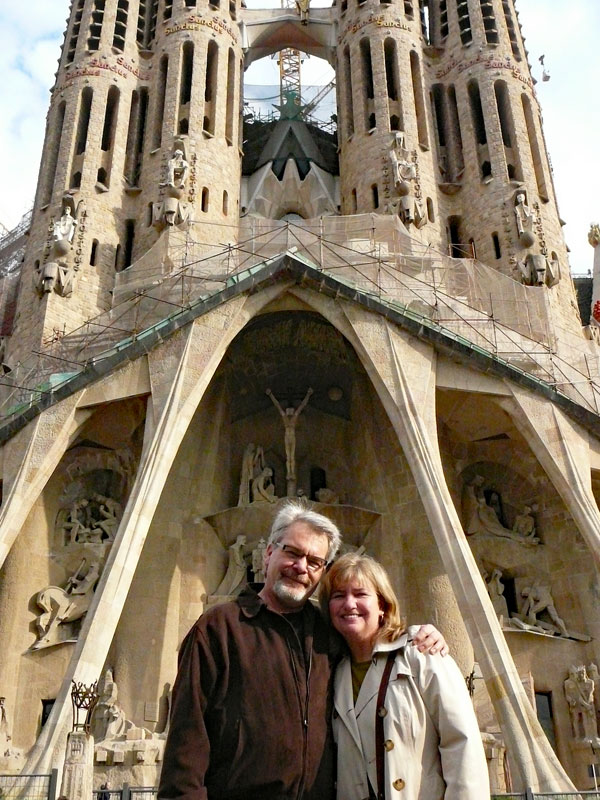
Posing at the main entrance
The facade of the Sagrada Familia with Neo-Gothic arches and buttresses
Contrasting architecture of the Sagrada Familia School built in 1909 for the children of the construction workers
The inside of the Sagrada Familia is spectacular and the columns and ceiling reflect the organic shapes of Gaudi's design. Along with the jewel-tone colors of the stained glass windows, the overall effect is magical.
View of the inside (Photo from Sagrada Familia website)
The magnificent ceiling and stained glass windows (Photo from Sagrada Familia website)
Climbing to the Top
During our visit, we were able to climb up the internal stairs for a magnificent view over the roof, pinnacles, and city.
Climbing up the circular staircase
More stone carvings on the facade
View of two of the pinnacles
Looking out over the construction
A modernist figure looking over the city
Looking out at the facade below
Another view from the top
Looking down on the roof top of the Sagrada Familia School
Looking at one of the facades
Neo-Gothic influences
Another view of the construction
Sagrada Familia Museum
We were also enthralled by the Sagrada Familia Museum located in the basement of the Facade of the Passion. The museum showcases Antoni Gaudi's innovative design process, including his use of hanging models, and features original drawings, models, and photographs related to the Sagrada Família and Gaudi's life.
Structural models developed by Gaudi
More exhibits of his structural models
Since Our Visit
A year after our visit, on November 2010, Pope Benedict XVI consecrated the Basilica for religious worship and designated it a minor basilica.
On 12 November 2023, the Sagrada Familia inaugurated the four towers of the Evangelists with a mass, subsequent blessing, and lighting up for the first time. As part of the central group of towers, the four towers of the Evangelists surround the tower of Jesus Christ. Together with the tower of the Virgin Mary, five of the six central towers have been completed. The central tower of Jesus Christ is scheduled for completion in 2026, coinciding with the centenary of Antoni Gaudi's death, though some decorative elements and a stairway will continue to be worked on until 2034.
Parc Guell
Parc Guell was designed by Antoni Gaudi upon the request of Count Eusebi Guell, who wanted to build a stylish park for the aristocrats of Barcelona. The Count had planned to build a housing development that would take advantage of the views and fresh air; however, only two show houses were completed. Gaudi himself lived in one of them from 1906 to 1925, designed by architect Francesc Berenguer in 1904. The house is now a museum showcasing some of Gaudi's work. The park has an iconic entrance flanked by two Gaudi buildings.
Entrance to Parc Guell
Mosaics at Parc Guell
Mosaic detail of a curved wall
Looking down from the main entrance
Guitar player serenading the tourists
Retaining wall at Parc Guell
The expansiveness of Parc Guell
Gaudi House Museum
Detail from the Gaudi House
Art Nouveau furnishings in the Gaudi House Museum
More Art Nouveau furnishings
Casa Batllo
Casa Batllo is another UNESCO World Heritage Site and also a Barcelona icon. Josep Batllo granted Antoni Gaudi full creative freedom of a project that initially entailed demolishing the building to construct a new home for the Batllo family. However, Gaudi ruled out demolition of the house and fully renovated it between 1904 and 1906. Gaudi completely changed the facade, redesigned the internal space, and expanded the light well — converting the inside into a true work of art. Casa Batllo is no longer owned by the Batllo family and since the 1990s has been owned by the Bernat family who have fully restored the house. In 1995, the family opened the house to the public, and also offers the use of the building for events.
The facade of Casa Batllo
Looking out to street from Casa Batllo entrance
The first floor hall at Casa Batllo
Sculptural stairway leading upstairs
A room at Casa Batllo
Another hallway
Peter photographing the central light well
The ornate central light well
One of the many beautiful mosaics at Casa Batllo
An upper floor terrace
Another view of the terrace
Rooftop of Casa Batllo with fanciful chimneys
Me admiring the chimneys
View of one of the mosaic towers
Old Town
Barcelona's old town is a historic area encompassing the Gothic Quarter, El Raval, and La Ribera. It has narrow streets, picturesque squares, and iconic landmarks — which gave us a glimpse into the city's Roman and medieval past.
Narrow streets in the Gothic Quarter
Another narrow street the Old Town
Barcelona Cathedral is a prominent landmark in the Gothic Quarter. The cathedral was constructed from the thirteenth to fifteenth centuries, with the principal work done in the fourteenth century. It has a beautiful cloister with 13 white swans.
The cloister with white swans at the Barcelona Cathedral
Other Interesting Buildings
Walking through the streets of Barcelona, we saw many interesting buildings — many by Antoni Gaudi but many more by less known architects. The interiors of the buildings we visited were as unique as the building facades.
Casa Mila, popularly known as La Pedrera in reference to its unconventional rough-hewn appearance, is the last private residence designed by architect Antoni Gaudi. It was built between 1906 and 1912 was commissioned by Pere Mila and Roser Segimon. The main floor of this new building, Casa Mila, was to be their home and they would rent out the other apartments.
Facade of Casa Mila by Antoni Gaudi
Another Art Nouveau building
Many wrought iron balconies
La Rotonda designed by Adolfo Ruiz Casamitjana in 1906
Torre Glories skyscraper constructed in 1999 at the gateway to the technological district in Barcelona
Friezes designed by Pablo Picasso around the facade of the Catalonian Association of Architects building
Interior of the Palau Baro de Quadras
Another beautiful interior
A fresco on a vaulted ceiling
Montjuic Hill
On another day we climbed the stairway up Montjuic Hill to visit the Foundation Joan Miro. There are also several sculpture gardens around Montjuic Hill including the Laribal Gardens. A small garden next to the Foundation Joan Miro has a statue by Josep Montserrat from 1909 that represents a typical Catalan mountain man. In the Laribal Garden we saw a beautiful statue by Josep Viladomat from 1925.
Looking down from the top of Montjuic Hill
A sculpture by Josep Montserrat
Peter admiring another sculpture at Laribal Gardens
Entrance to the Laribal Gardens on Montjuic Hill
A sculpture by Josep Viladomat
The Foundation Joan Miro
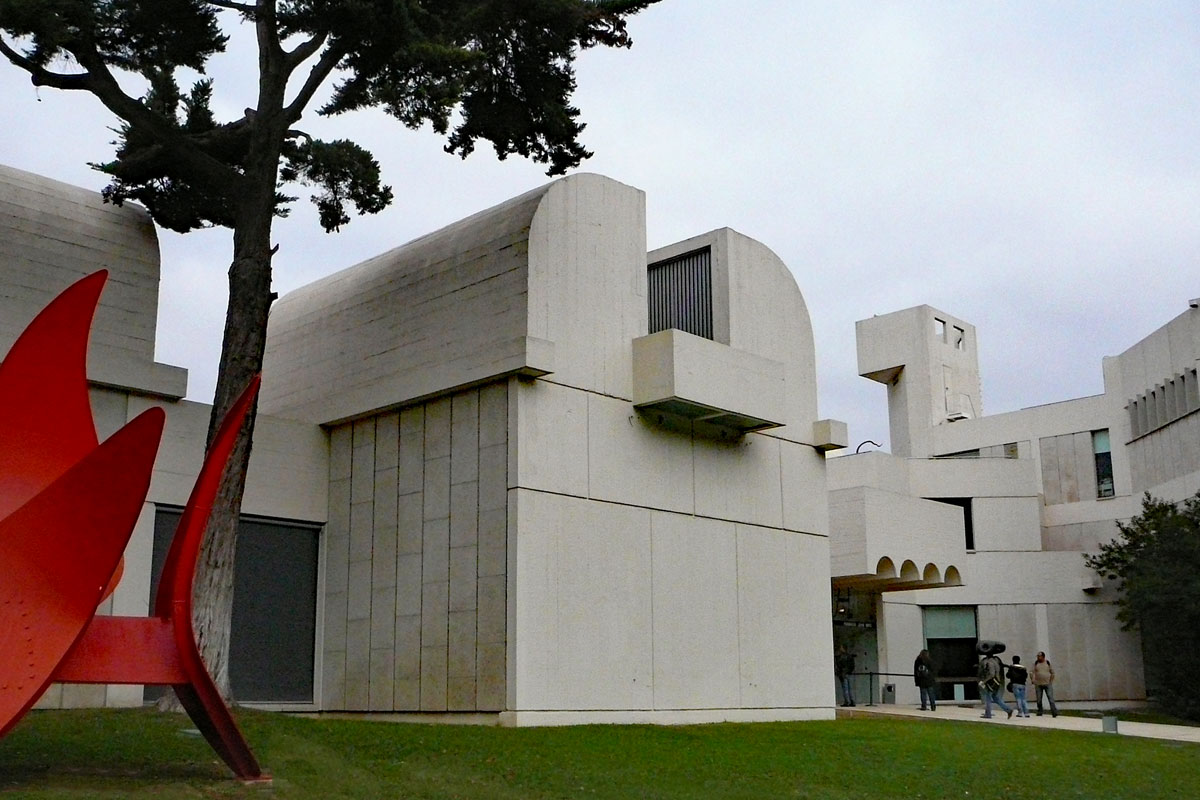
We spent most of the day at the Foundation Joan Miro located in a building designed by the Josep Lluis Sert which is integrated into the landscape of Montjuic Hill. This modern art museum honors the life and work of the Spanish artist Joan Miro and was created by Miro himself, starting with works from his own private collection.
Foundation Joan Miro designed by Josep Lluis Sert
The museum is now home to 14,000 pieces of art by the Catalan artist who also collaborated with the architect on the building. It opened to the public in 1975 and provides and overview of the artist’s art and life and also displays the work of other artists from the 20th and 21st centuries.
A large sculpture by Joan Miro in the courtyard
Another Joan Miro creation
A large scale tapestry by Joan Miro on display
A fanciful sculpture by Joan Miro
Another Joan Miro sculpture
More Joan Miro creativity
Barcelona Waterfront
After years of Barcelona's access to the sea being obstructed by warehouses and railway tracks, the waterfront was rebuilt prior to the 1992 Barcelona Olympics as part of a major urban renewal program. Aside from sand being imported to create several beaches, there are hotels and restaurants and a busy marina. The Barcelona Aquarium which opened in 1995 is a particularly striking building with the roof shaped like a fish.
Boats in a waterfront marina
The Barcelona Aquarium
The Contrast of Old and New
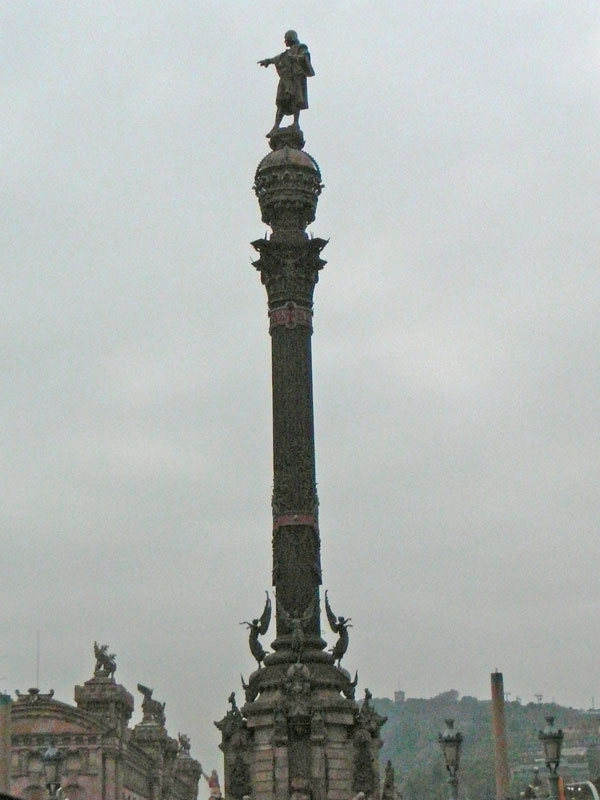
The Columbus Monument, located at the lower end of La Rambla, was constructed in 1888 for the Exposicion Universal de Barcelona in honor of Columbus' first voyage to the Americas. This is a real contrast to the Montjuic Communications Tower completed in 1992 for Telefonica to transmit television coverage of the Summer Olympic Games in Barcelona. Designed by Santiago Calatrava, it represents an athlete holding the Olympic Flame. Because of the tower's orientation, it also works as a giant sundial using the Europa Square to indicate the hour.

 As an architect, I had always wanted to visit Barcelona. The 19th and early 20th centuries marked Barcelona's golden age of Modernism, a Catalan Art Nouveau movement that sought to revive and celebrate Catalan culture. Antoni Gaudi, the visionary architect, became synonymous with this movement and his iconic works like La Sagrada Familia, Park Guell, and Casa Batllo transformed the city's landscape with organic forms and vibrant colors.




 Parc Guell was designed by Antoni Gaudi upon the request of Count Eusebi Guell, who wanted to build a stylish park for the aristocrats of Barcelona. The Count had planned to build a housing development that would take advantage of the views and fresh air; however, only two show houses were completed. Gaudi himself lived in one of them from 1906 to 1925, designed by architect Francesc Berenguer in 1904. The house is now a museum showcasing some of Gaudi's work. The park has an iconic entrance flanked by two Gaudi buildings.