While traveling in Thailand in February 2006, Peter and I decided to go to Cambodia for four days to visit the famous Angkor region — a UNESCO World Heritage Center. After confirming that we could get a tourist visa at the Siem Reap Airport, we booked a flight from Bangkok and reserved a room at the Sofitel Hotel in Siem Reap. We hired a guide for several days who escorted us around the major archeological sites. Beyond the Angkor Wat temple complex, we also visited the temples at Bayon, Ta Prohm, Banteay Srei, and Phnom Bakheng, and spent a morning visiting the boat communities of Tonle Sap Lake.
Arriving at the Siem Reap Airport
Starting Out at Angkor Wat
The Angkor temple complex is one of the most important archaeological sites in Southeast Asia and was the center of the Khmer Kingdom for several centuries. It extends over 150 square miles and consists of many temples, reservoirs, and canals. Angkor Wat was originally constructed during the 12th century as a Hindu temple dedicated to the god Vishnu for the Khmer Empire, but it was gradually transformed into a Buddhist temple toward the end of the century, and described today as a Hindu-Buddhist temple. The word Angkor means Capital City in the Khmer language, while the word Wat means Temple.
Approaching the Angkor Wat
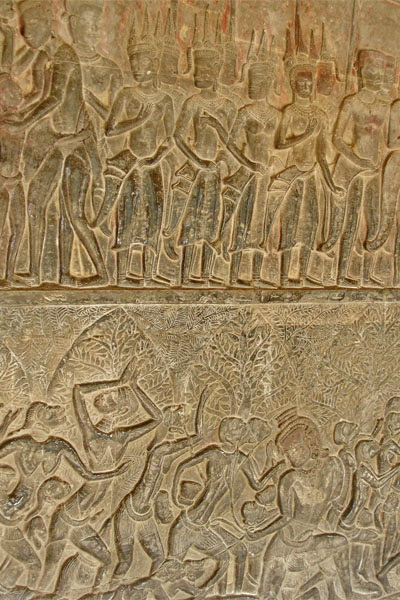
We spent three hours wandering around the grounds of Angkor Wat with our guide who expained its history. The vast area is dotted with gorgeous balustrades, galleries, chambers, courtyards, corridors, and porches. A huge rectangular moat surrounds the temple, which rises through a series of terraces to the central shrine, towering at a height of 669 feet. The bas-reliefs encircling the temple on the first level depict Hindu epics while those carved into the wall of the third enclosure include thousands of female dancers.
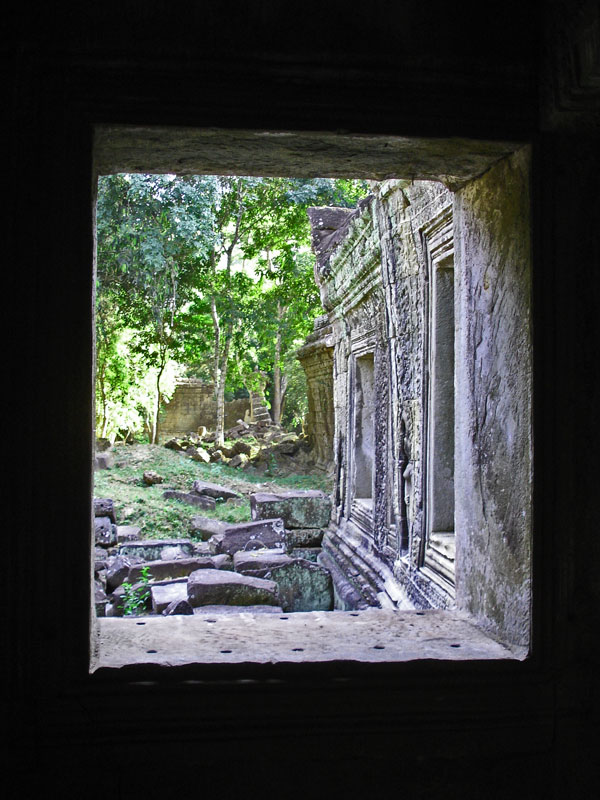
View through a window at Angkor Wat
Colonnade at Angkor Wat
Restoration of the bas-reliefs
Bas-relief of dancers
Other stone carvings at Banteay Srei Temple
Bayon Temple
The Bayon Temple is a richly decorated Khmer Buddhist temple built in the late 12th or early 13th century at the center of the massive Angkor Thom complex. Its most distinctive feature is the serene and smiling stone faces of Brahma on the many towers which jut out from the upper terrace and cluster around its central peak. The temple rises through three levels to a height of around 140 feet. The outer gallery on the first level is home to some well-preserved bas-reliefs which are thought to depict scenes of everyday life and historical events, featuring everything from armies to acrobats, while the inner gallery on the next higher level depicts mythical figures and stories. The third level includes the large stone faces. Monks in orange robes can be see around the Bayon Temple as well as the other temples that we visited.
Young monks walking aroung the temple grounds
Me with our guide looking at one of the Bayon heads
It is difficult to take photos of the various ruins that we visited, particularly at Bayon. The enormous size of the carved heads and other figures is hard to capture in a single shot.
Example of massive smiling head at the Bayon Temple
Altars and Offerings Everywhere
Walking around the various temple grounds, we frequently discovered small altars and decorated Buddhas which were well-maintained.
Decorated and adorned statues
Another decorated Buddha
1 / 10
Large carved figures at Angkor Wat
2 / 10
Monks visiting the ruins
3 / 10
View of one of the walls and surrounding moat at Angkor Wat
Ta Prohm was built in the Bayon style in the late 12th and early 13th centuries and is believed to be the first temple built entirely of sandstone. Founded by a Khmer King as a Buddhist monastery and university, it was home to more than 12,000 people, including 18 high priests. Another 80,000 people, who maintained the temple, lived in the surrounding villages. Unlike most Angkor temples, Ta Prohm is in much the same condition in which it was found — with gigantic trees and tree roots intertwined with the crumbling stone structures giving it an eerie quality.
The famous overgrown tree roots at Ta Prohm Temple
Stray dog at Ta Prohm Temple grounds
Detail at Ta Prohm Temple
One of the bas-reliefs at Ta Prohm
Stone carving with tuk-tuk for scale
Peter and I posing under the massive tree roots
Hidden views of more ruins
A statue peeking through an overgown tree trunk
Banteay Srei Temple
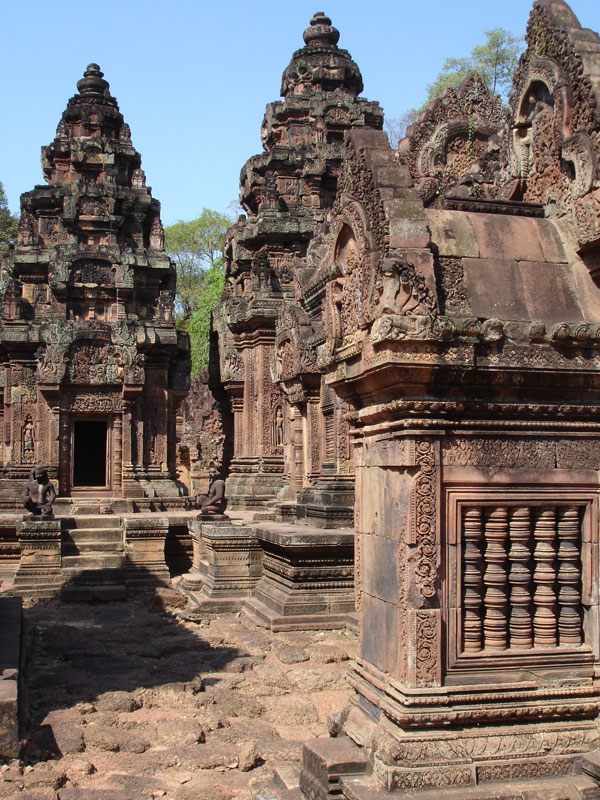
Banteay Srei is a 10th-century Cambodian temple dedicated to the Hindu god Shiva. It is built largely of red sandstone which lends itself to the elaborate decorative wall carvings which can still be seen. The buildings themselves are miniature in scale compared to other Angkor construction. Banteay Srei is about 20 miles away from Siem Reap. As we drove through the Cambodian countryside we could see the Cambodian people going about their daily lives.
Entrance to colonnade at Banteay Srei Teeple
Red sandstone buildings at Banteay Srei Temple
Phnom Bakheng Temple
Dedicated to Shiva, Phnom Bakheng was built at the end of the 9th century in the form of a temple mountain. Located atop a hill, it is a popular tourist spot for sunset views of the much bigger temple Angkor Wat, which lies amid the jungle about a mile to the southeast. Although the sunset was beautiful, it was quite hazy and we were intimidated by the large number of visitors given that Phnom Bakheng is one of the most threatened monuments of Angkor.
Panoramic view of the sunset at Phnom Bakheng Temple
View of Angkor Wat from the top fo Phnom Bakheng Temple
Family making an offering at the Phnom Bakheng Temple
1 / 4
View of courtyeard at Ta Prohm Temple
2 / 4
Massive overgrown tree roots
3 / 4
Elaphants waiting to take customers to the top of Phnom Bakheng Temple
4 / 4
The top of Phnom Bakheng Temple overloaded with people awaiting the sunset
Tonle Sap Lake is the largest freshwater lake in all of Southeast Asia. Located about 9 miles south of Siem Reap, it is a diverse ecosystem and home to several floating villages. The lake also works as a natural floodwater reservoir for the Mekong water system by regulating the water downstream from Phnom Penh during the wet season. Tonle Sap Lake’s size varies from 6,000 square miles in the wet season to 1,000 square miles during the dry months. This way, the lake balances the water of the Mekong River, by increasing the size and collecting extra water in the wet season and flowing back to the river and Mekong Delta in the dry season.
Panoramic view of floating structures at Tonle Sap Lake
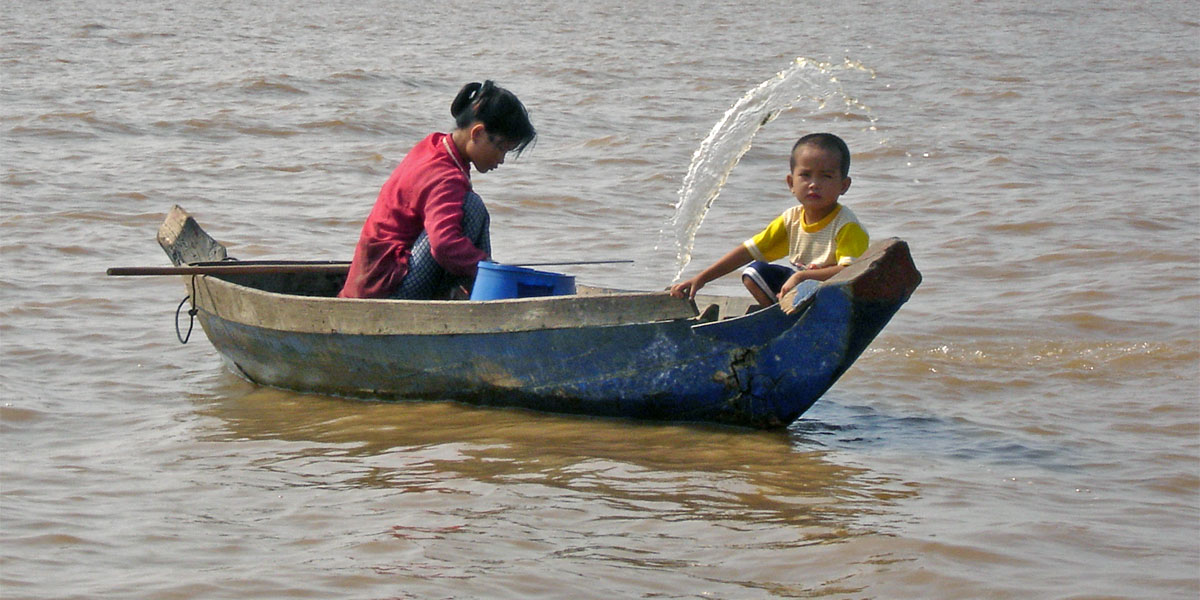
The communities at Tonle Sap Lake virtually live on the water in boats. The communities living in these villages make a living from what the lake provides — mainly fishing, shrimp and crocodile farming, selling dry fish, or making boats. Right from their childhood, instead of walking or using any other vehicle, everyone commutes in boats. They also bathe, wash clothes, and clean their homes from the lake’s water. These floating communities are fully functional with floating schools, shops, clinics, and a generator for electricity.
1 / 9
Arriving at one of the floating communities at Tanle Sap Lake
2 / 9
View at Tanle Sap Lake with chicken coop suspended on the water
We stayed at the Sofitel Hotel in Siem Reap which had well-manicured grounds and a comfortable room in our preferred minimalist style. The food was always delicious and displayed artistically, whether in a restaurant or a local market. In the town itself, there was not really much to see or do — of course much has changed since we were there in 2006 when there were dirt roads and minimal tourist infrastructure. On our way to Tonle Sap Lake we were able to see the countryside as well as stop a a silk weaving factory.
One of our meals at a local restaurant
Display at a local market
A weaver at the silk factory
Examples of the beautiful ikat weaving
1 / 10
The pastoral countryside along the route to Tanle Sap Lake
2 / 10
Another scene of the countryside
3 / 10
Typical Cambodian houses
4 / 10
Another Cambodian house — always on stilts prepared for monsoon season
Leaving the Siem Reap Airport to return to Bangkok
Postscript. Although it does not seem that long ago that we visited Siem Reap, we understand that much has changed. We were fortunate that when we visited there were very few other tourists at the temples — except for the one night that we climbed up to the top of the Phnom Bakheng Temple to see the sunset over Angkor Wat (a mistake). The town of Siem Reap had dirt roads and there was not much to do. One thing that saddened us, however, was the amount of trash throughout the town although the temple grounds were never littered. After returning from Cambodia, we vowed to avoid using plastic bags whenever possible and have kept this promise since then.