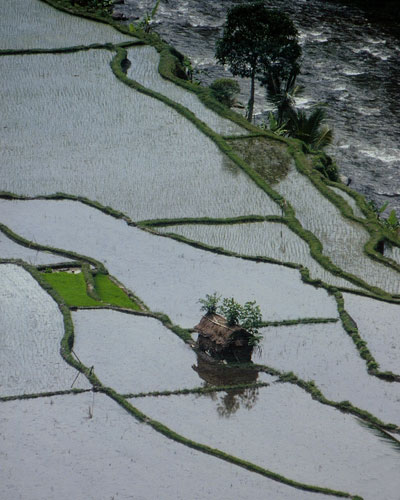
Note that these photos were taken with a film camera so all images were scanned from slides or printed photos except where noted.
In 1991, Peter and I traveled through Indonesia for several weeks over the Christmas and New Year holidays. After reading an article about Bali in a travel magazine, I contacted an Indonesian tour company who helped us with our itinerary and hotel reservations.
We started out in Jakarta on the northwest coast of the island of Java, and then flew to Jogyakarta in the central part of the island. After spending several days in central Java, we flew east to Denpasar on the island of Bali. We spent most of our time traveling around Bali and then flew to Singapore for a brief visit before traveling back home. While the majority of Indonesians are Muslim, most of the Balinese people identify as Hindu with a long history of rituals, traditions, and the arts which preceded the introduction of Islam in the country.
I kept a detailed, day-by-day diary of this trip which is always enjoyable to read years later.
A Very Long Flight
Arriving in Jogyakarta, we realized that we had not seen daylight in two days! Our plane left Detroit Metro Airport four hours late so we missed our connection to Singapore. Northwest Airlines arranged for us to stay overnight in Tokyo (in a village by the airport) at Japan’s version of a Best Western Motel, and then to fly directly to Jakarta on Garuda Airlines rather than go through Singapore.
Depending on the winds, the flying time between Detroit and Tokyo varies from 11 to 16 hours (our flight was about 13 hours). Our Garuda flight to Jakarta took another seven hours. The music on the plane sang it’s beginning to look a lot like Christmas — we wondered how you can really tell in the tropics. The stewardesses wore lovely ikat blue and green long narrow skirts with blue tailored jackets and the male attendants looked like waiters. We were served champagne as we crossed the equator!
Arriving in Jogyakarta, Central Java
We arrived in Yogyakarta in the evening, met by our driver who took us to the Duta Guest House which was about 25 minutes from the airport in Yogyakarta. It was strange arriving at night and trying to sleep with no idea where we were. The lobby was very primitive and the furnishings in our guest room were marginal but it faced a courtyard with lovely tropical landscaping. Although our guest room had a window air conditioning unit and a door directly into the bathroom, the bathroom was actually outside with no ceiling over the tiled floor and bath tub (and sink and toilet fixture). There were little lizards everywhere but they were not threatening. Breakfast the next morning was served on an open-air terrace with very friendly and accommodating staff.
The next day our guide took us on a Yogyakarta city tour, a visit to the bird market (a little bit of a culture shock), and the usual stops at puppet, batik, and silver factories (fortunately not much high-pressure salesmanship). We also went to Kraton, the sultan’s palace that was not as elegant as one would expect.
Borobudur
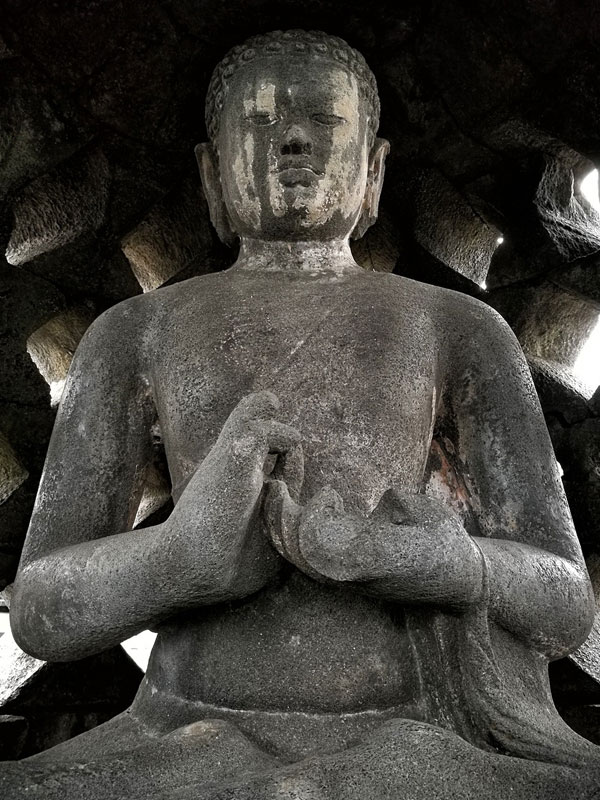
Our next visit was to Borobudur. Designated a UNESCO World Heritage Site, this famous Buddhist temple, dating from the 8th century, is the most important tourist site in central Java. It was built in three tiers — a pyramidal base with five concentric square terraces, the trunk of a cone with three circular platforms and, at the top, a monumental stupa. The walls and balustrades are decorated with fine bas-reliefs. Around the circular platforms are 72 openwork stupas, each containing a statue of the Buddha. We had an excellent guide who recited some very entertaining stories about the bas-reliefs on the temple walls.
Overview of Borobudur with its pyramidal base and five concentric square terraces
Borobudur was built in the eighth century and is considered to be one of the most magnificent Buddhist shrines in the world. It fell into decline during the 10th and 11th centuries when there was a transfer of power from central Java to the east. For centuries it lay forgotten — buried under layers of volcanic ash and jungle growth. In 1815 Europeans cleared the site and in the 1900s the Dutch began its restoration which continued into the 1980s.
View of the many stupas from the top of Borobudur
One of the 72 Buddhas within the Borobudur stupas
Example of the Borobudur bas-reliefs which tell a story
Kraton
A true city in the city, the Kraton is the spiritual and royal center of Yogyakarta. The Keraton (or the Sultan's Palace) is a grand complex that was built in 1755 according to the guidance of Hindu-Javanese cosmology. The north entrance is turned to Mount Merapi, seat of the gods, while the south gate opens towards the sea, domain of the goddess Nyai Loro Kidul.
The colorful Kraton complex (Sultan's Palace)
Heading for Denpasar, Bali
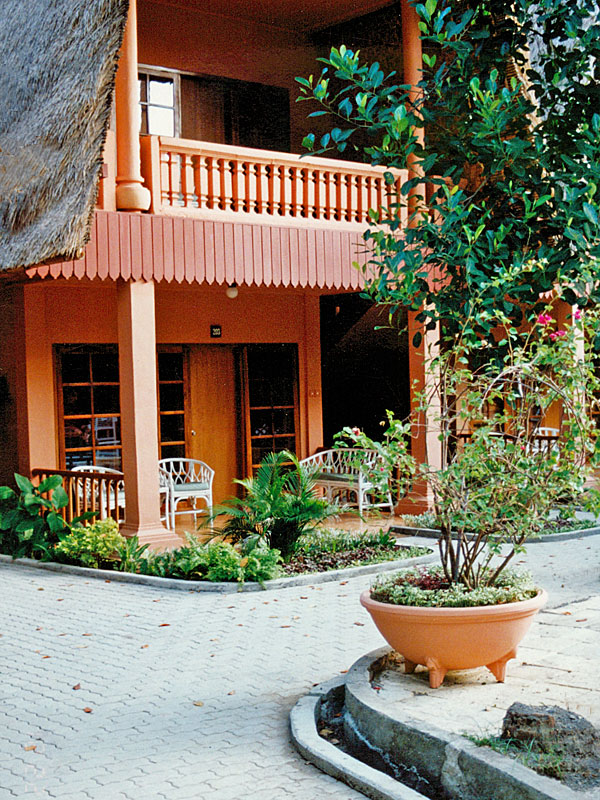
We flew from Yogyakarta to Denpasar on the island of Bali and arrived at the Segara Village in the afternoon. Located in Sanur, this locally-owned complex on the south shore was designed as a traditional Balinese village with beautiful tropical landscaping. It was also a short walk to the beach. The Segara Village had a charming central lobby and an open-air restaurant. We were assigned a bungalow with Balinese furnishings, wood shutters, a nice bathroom, and an outdoor porch and patio that faced one of the two pools. There were other two-story units resembling traditional rice granaries and many statues along the connecting walkways.
Our bungalow at the Segara Village
One of the Segara Village staff
Beautifully landscaped paths
More paths among the bungalows
A bungalow resembling a traditional rice granary
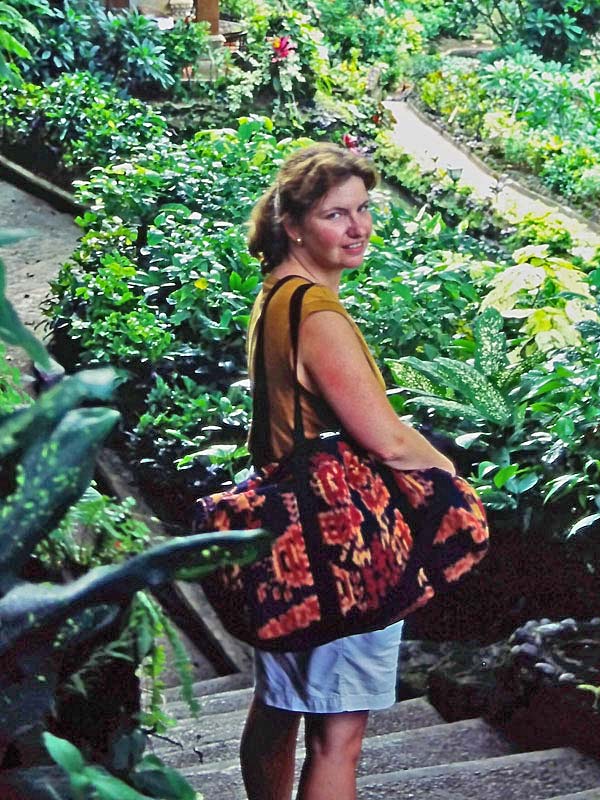
Ready for a day of sightseeing
Peter sitting outside our bungalow
Statues and Offerings Everywhere
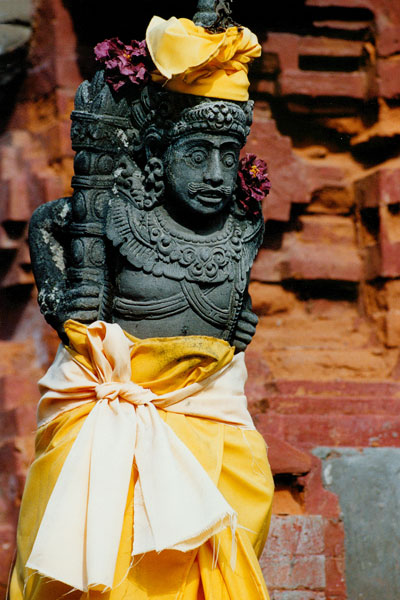
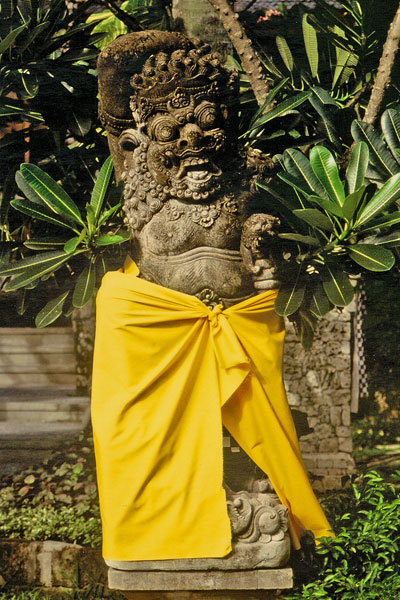
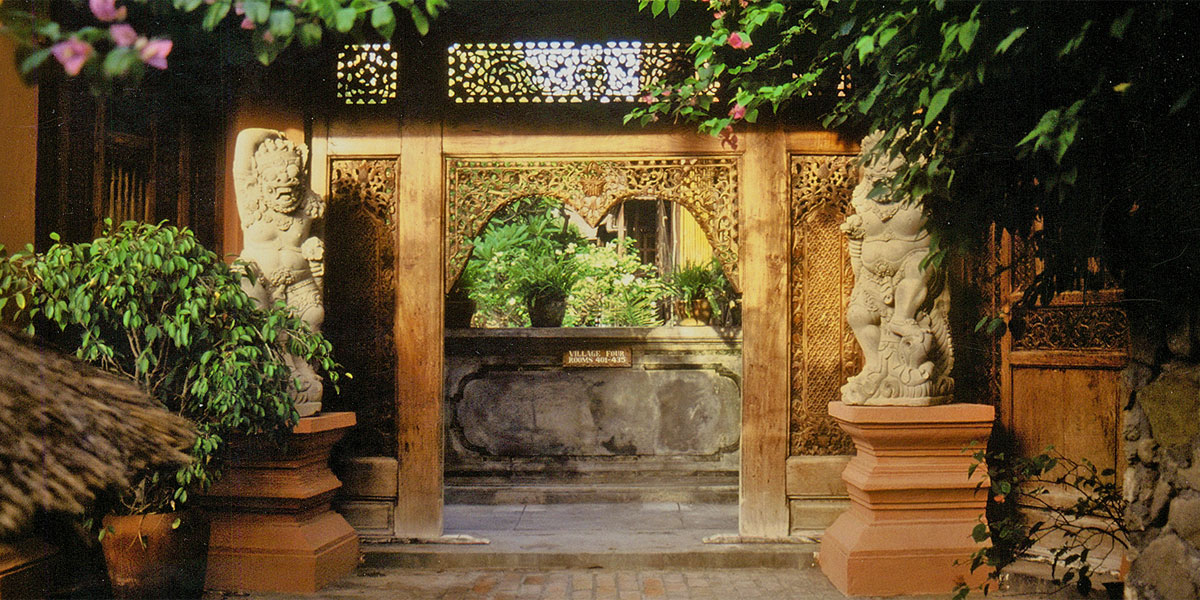
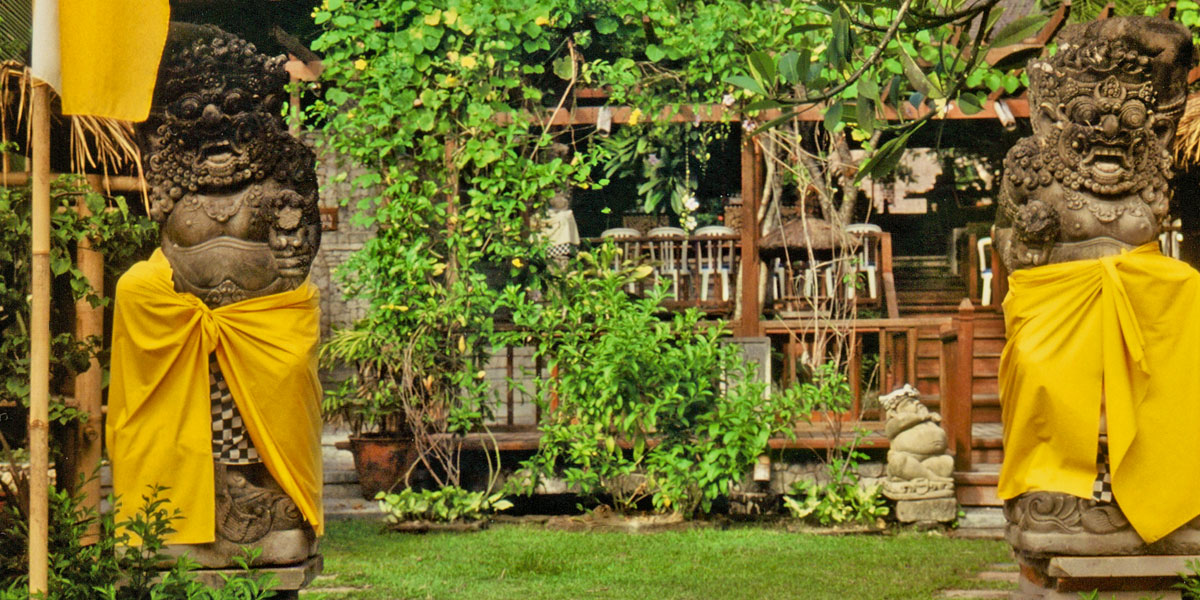
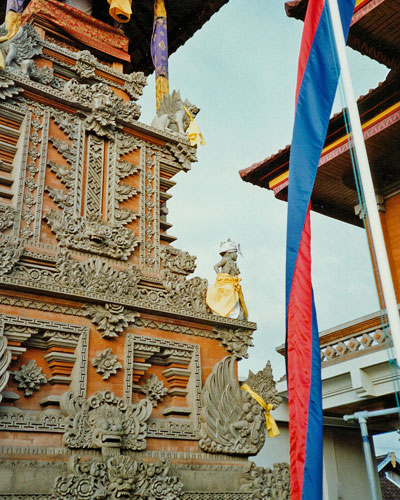
There were many statues depicting gods, demons, and Balinese mythological deities along the connecting walkways in the Segara Village and almost everywhere we went in Bali. Most of the statues were wrapped in various colored (usually checkered) cloths. We also encountered offerings placed in unexpected places.
A statue wrapped in ceremonial yellow cloth
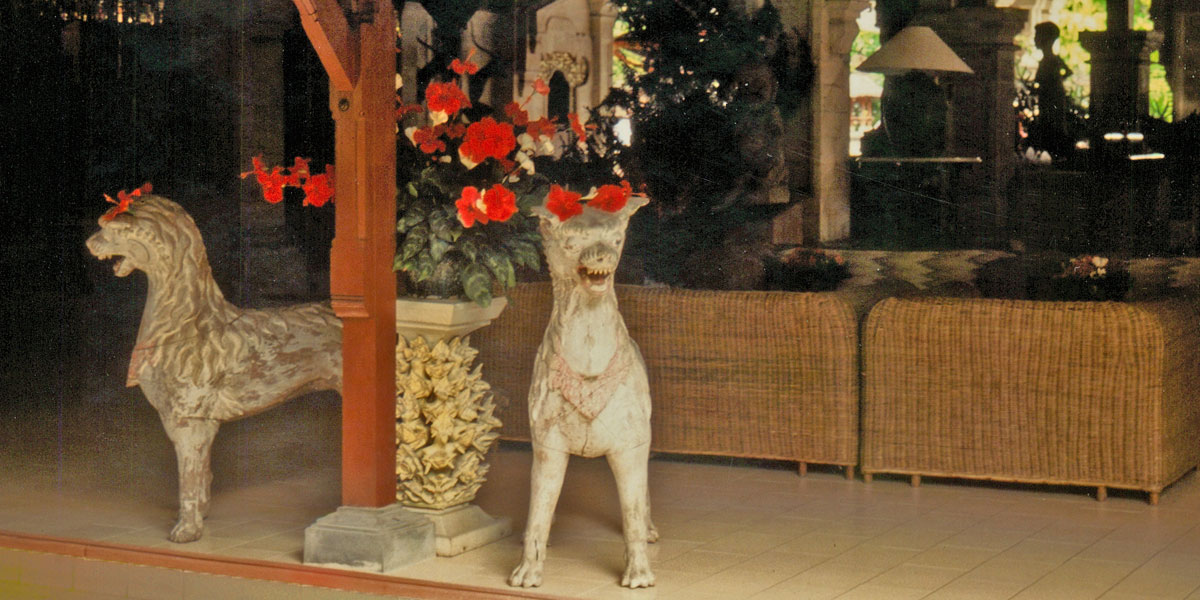
A statue adorned with flowers
Another decorated statue
Balinese Hinduism encompasses animism which is a belief that many objects also have a spirit. This may be rocks, trees, rivers, mountains, or even man-made objects such as temples, statues, and musical instruments. If something is believed to have a spirit, then the object’s special nature is signified by a wrappings of different colored (usually checkered) cloths. Hence, you will often see banyan trees and temple statues dressed up as if they are human beings. Some people like to decorate them further with flowers. When wrapped in such a cloth the object becomes sacred.
An offering in an unexpected place
Another small altar
A pond with water lilies
The welcoming lobby at the Segara Village
1 / 14
Looking through the lobby to the village
2 / 14
Another sitting area
3 / 14
One of the many lounge areas furnished with Balinese antiques
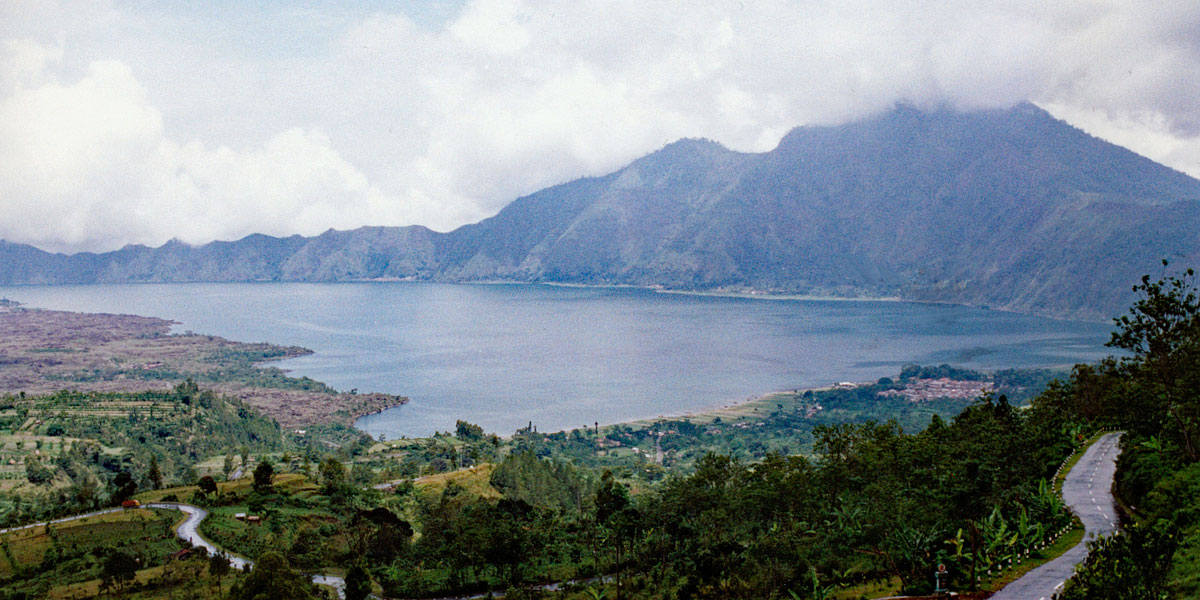
After breakfast, we departed with a driver and guide for Kintamani (the volcano) and stops at several villages along the way. We also stopped at the temple and summer home of former Indonesian president Sukarno who was the first president of independent Indonesia.
Panorama view of the Kintmani Volcano
View over the Kintamani Volcano crater lake
Another view near the volcano
We drove through the villages of Celuk, Batabulah, and Sukawati, Batuan, and Mas and stopped at several tourist shops along the main road. We were impressed with the family businesses where we stopped — wood carving, stone carving, kite making, weaving, and other crafts. The whole family often live together with their showroom near the roadside and their living quarters connected. Most family complexes have beautiful gardens, a temple or shrine in the center, and a music stage with full gamelan orchestra and instruments all set up. We were told that most families also form their own orchestra for entertainment.
The sacred spring of Tirta Empulat at Tampak Siring
Water lilies in the pool
Tampak Siring and Central Bali
We then visited the temple and gardens and the sacred spring of Tirta Empulat at Tampak Siring just beneath the former summer home of Sukarno. This region of central Bali was once the epicenter of a powerful Balinese kingdom and has scenic rice terrace landscapes and two religious temples — Tirta Empul and Gunung Kawi. On Bali, both men and women must have their knees covered and wear a sash to enter a temple.
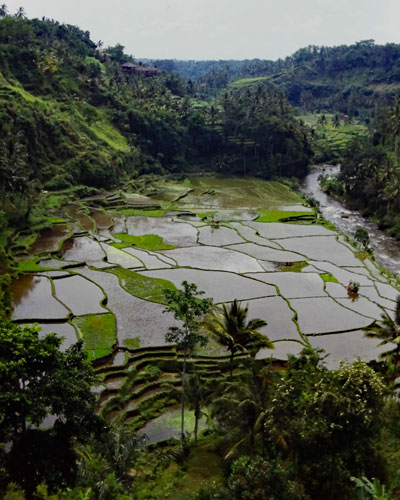
We ate lunch in a restaurant at the rim of the volcano crater. After lunch we headed south back to Sunar through some of the most beautiful rice-terraced land that we have ever seen. The Segara Village had a Christmas Eve buffet with entertainment — including a mesmerizing gamelan orchestra and a Balinese ballet (Samayama Ballet Troupe) which made for a wonderful evening.
Rural scene in central Bali
Christmas Day Snorkeling
We signed up for an all-day cruise aboard the Bali Hai 34-meter long catamaran which took us through the Badang Strait and then to the islands of Nusa Penida and Nusa Lembongan — about 25 meters from Benoa Harbor in Bali. We anchored just off Nusa Penida for a day of snorkeling and took turns riding on an inflatable water sausage, seating five people and pulled by a motor boat — cheap entertainment. We also went ashore to visit Lembongan Village. There was a buffet dinner mid-day on the catamaran with a traditional (trying hard) turkey dinner that was very good.
View of the coastline by Nusa Penida
Rock formation in the Badang Strait
Aboard our catamaran for the day
Visiting the Market in Denpasar
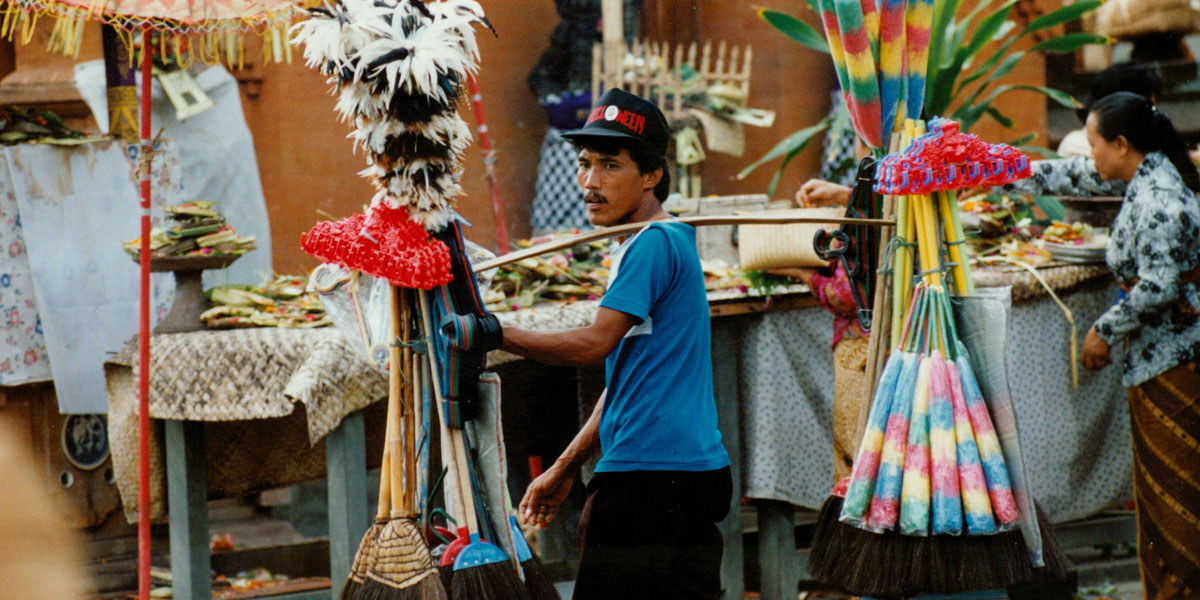
The next day we went to Denpasar in the early morning to see the largest market on the island. Along the way, we passed several charming tropical nurseries. We tried to find a place to eat breakfast in Denpasar (no such luck) so we settled for a very friendly Chinese restaurant. I had fried rice and tea and Peter had mixed vegetables and noodles and coffee. The market was very busy and visually interesting with so many unusual fruits and vegetables. Durian (stinky fruit) smells horrible, but is supposed to taste divine. We decided to come back early the next morning with our camera.
Denpasar was very noisy and chaotic and it was extremely hot and humid. Also, we saw very few Westerners. After the market, we walked to the Bali Museum which housed some unimpressive sculptures and ceremonial objects before heading back to our bungalow (and pool) in Sunar.
Looking down on the chaotic market in Denpasar
Visiting a shop with handwoven ikat fabric
Unusual fruits and vegetables at the market
The architecture of Denpasar
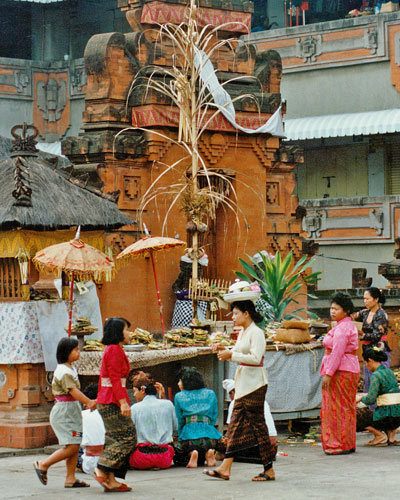
Activity at a shrine in Denpasar
Standing in front of the Bali Museum
1 / 6
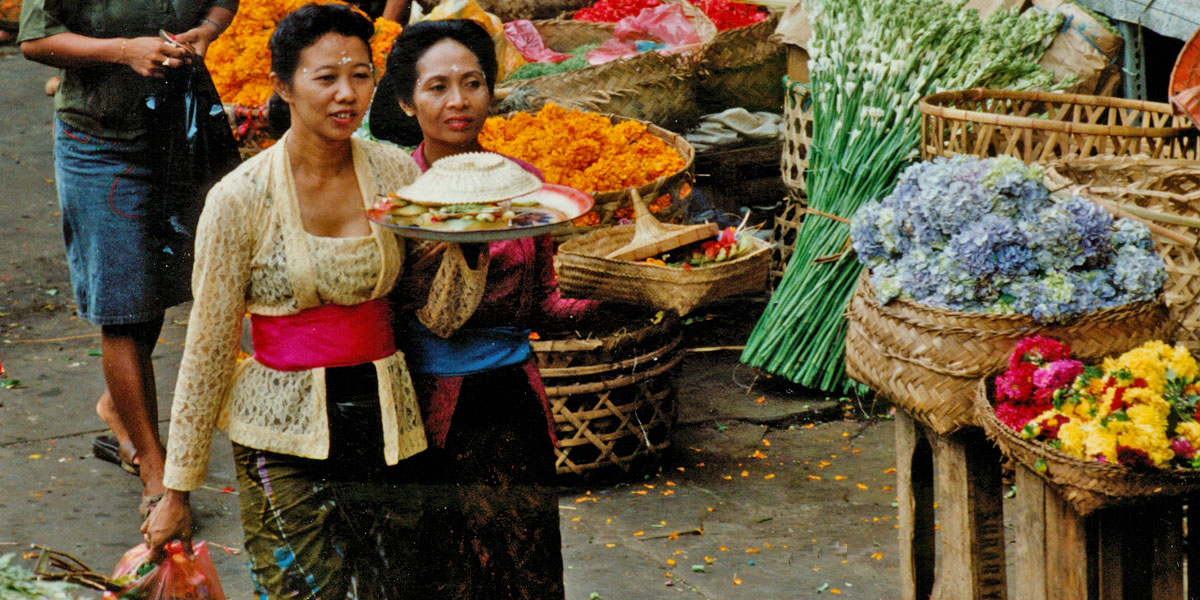
A market scene with Marigolds for making offerings
2 / 6
Many unusual fruits and vegetables
3 / 6
Another market scene
4 / 6
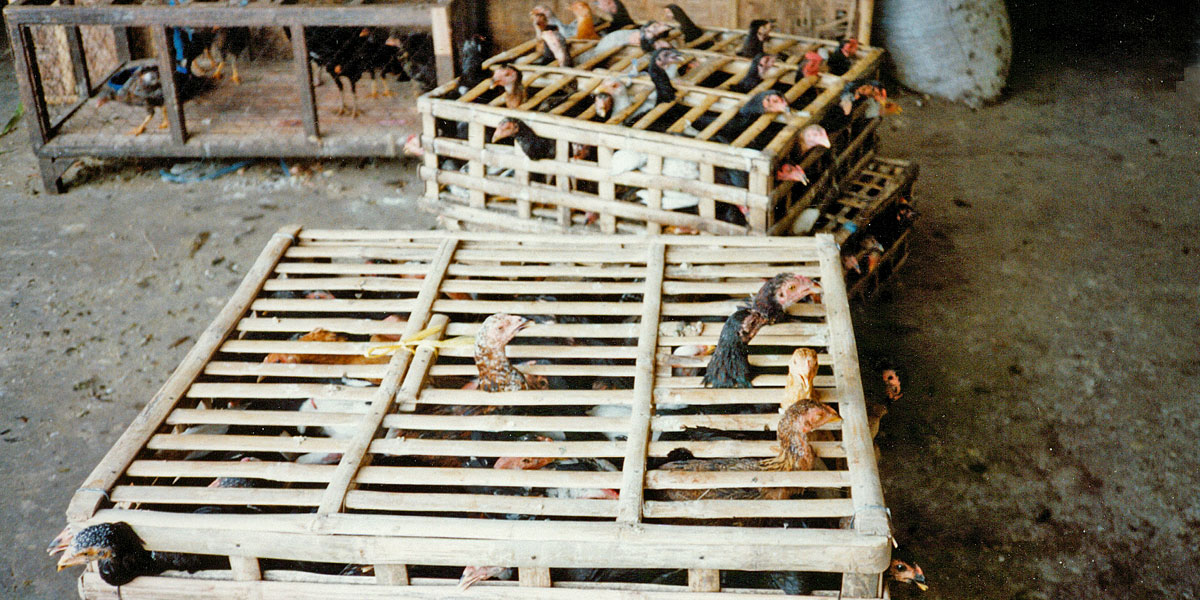
Chicken are always fresh in Bali; they are always sold live!
The next day, we took a taxi back to Denpasar to take some photos at the market. Because it was a Hindu holiday, many businesses were closed. We saw several processions along the way with groups of women all dressed up in the same outfit and carrying large baskets of fruit on their heads in a line to the temple. They then blessed the food to take it home to eat and also left some for offerings.
Roadside procession bound for the temple
More women carrying offerings
Intricate plates of food are carried through the street
Another worshippers heading for the temple
Tanah Lot
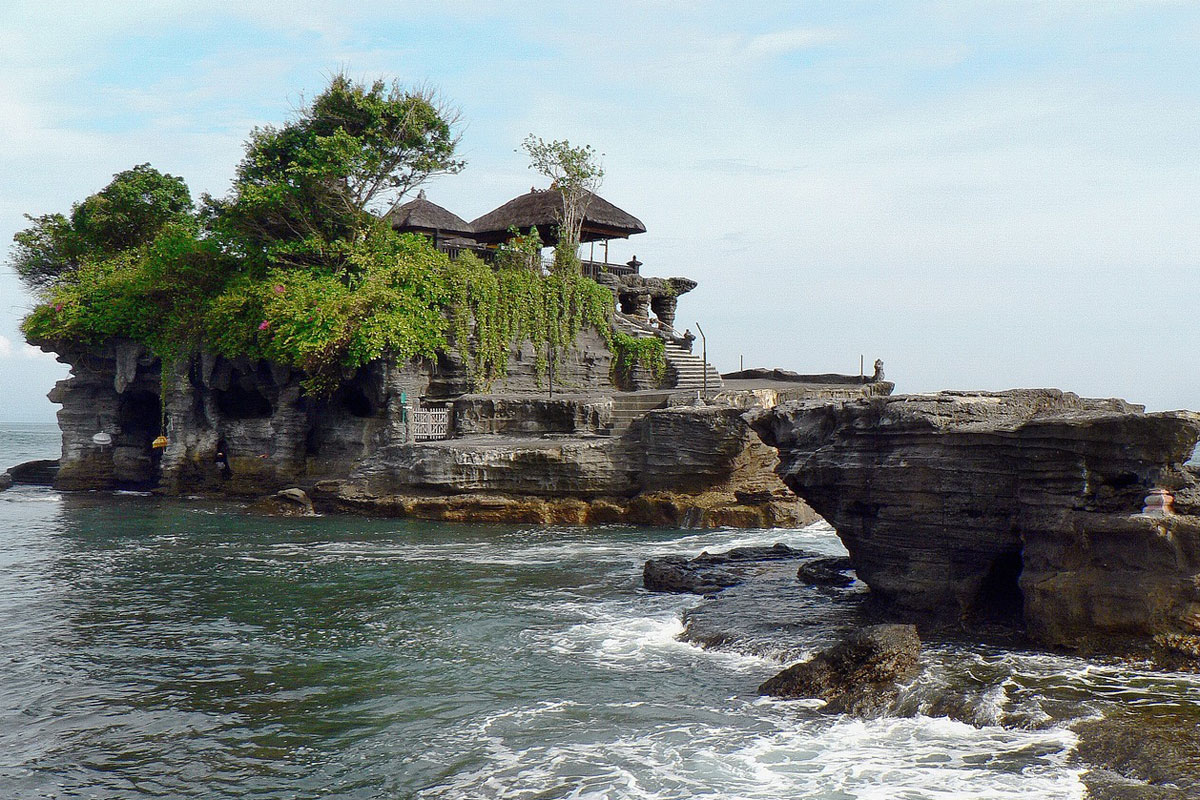
Tanah Lot — northwest of Denpasar — is a large offshore rock formation which has been shaped continuously over the years by the ocean tide. It is home to the ancient Hindu pilgrimage temple Pura Tanah Lot which was constructed in the 16th century. Many local people were climbing up to the temple to make an offering and to bless their food with holy water.
View of the Pura Tanah Lot temple perched on an impressive rock formation
Locals descending after blessing their food
More local people at Tanah Lot
Departing for Ubud
We left the Segara Village in Sanur and drove to Ubud for another two days. We arrived at the Caheya Dewata Guest House around noon which was just outside the village of Ubud. Our bungalow was a short hike from the reception pavilion down a narrow path past a lovely pool. Our stay was a bit like camping; our lodging had a high thatched roof and a primitive bathroom — although very charming with a balcony overlooking a river valley. We really felt like we were in the jungle with many birds, geckos, and bugs everywhere. In particular, the view overlooking the Ayung River valley with rice terraces and mountains and a white water stream was outstanding. Later in the day, we took a taxi into Ubud and had lunch at a charming restaurant by a bridge with a waterfall.
The impressive view of the Ayung River valley from the Caheya Dewata Guest House
Another view of the river valley
Rice paddies surrounding a house
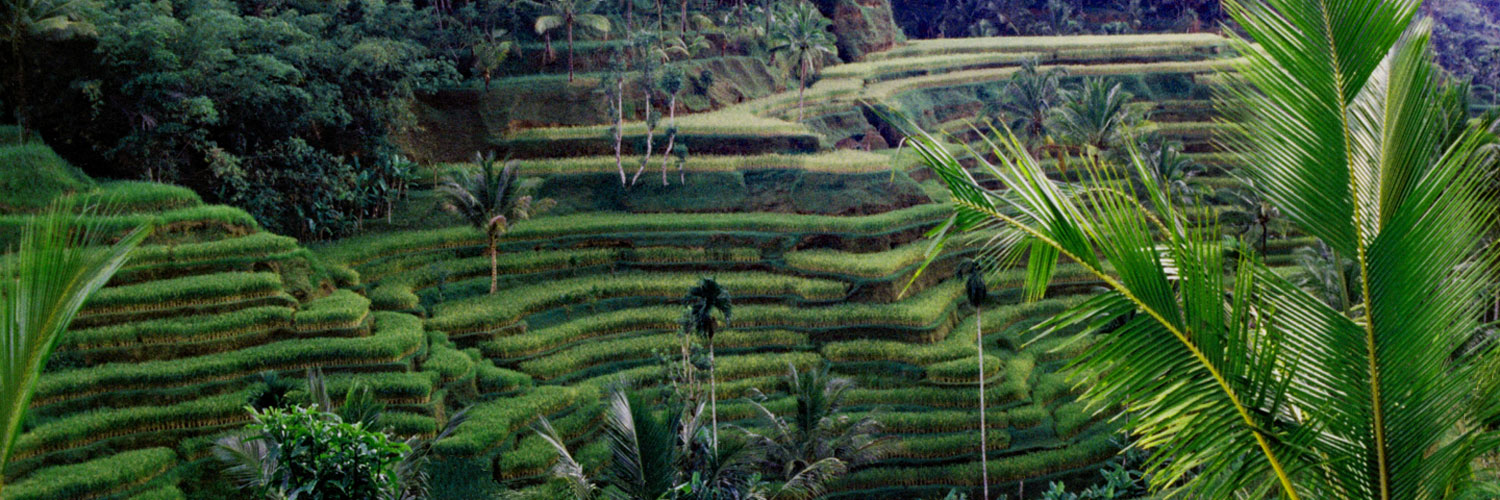
Intricate terraces along the hillside
Visiting the Sangeh Monkey Forest
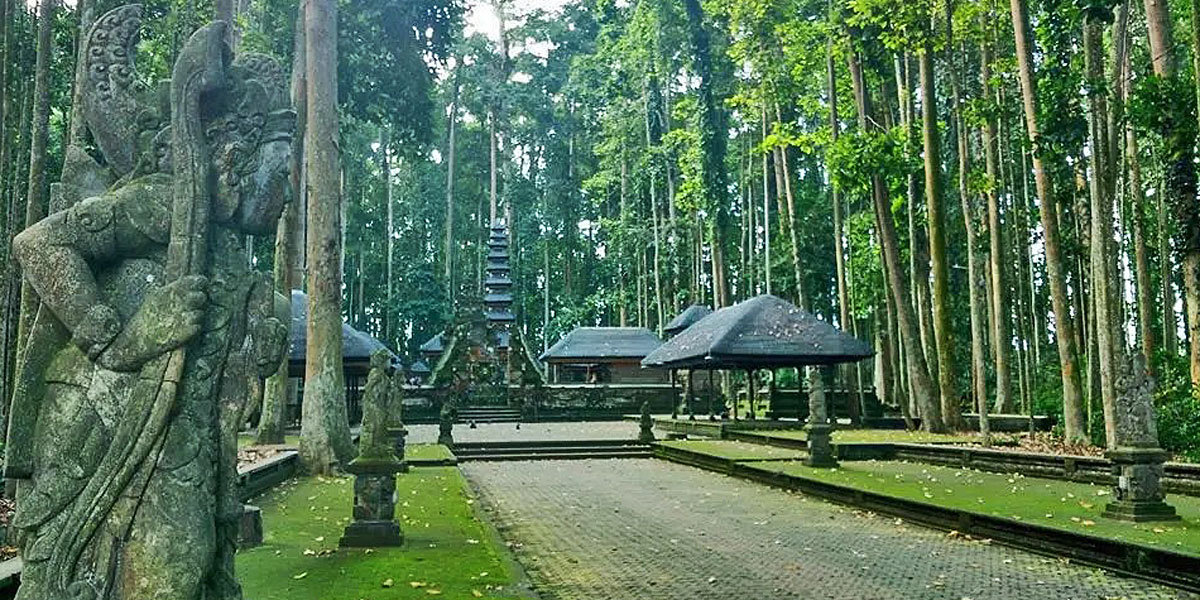
The next day we took a taxi to the end of Monkey Forest Road and walked through the Sangeh Monkey Forest Sanctuary. There are over 100 individual monkeys living at the site and they roam freely through the forest. The monkeys can become really pesky if they think that you have food. We saw one man almost get his pants torn off because he had a bag of peanuts in his pocket. The Forest itself covers about 50 acres and is lush with greenery. We were told that he forest also has many other types of wildlife, including civets, bats, and cats. We saw many statues and carvings depicting demons, gods and Balinese mythological deities throughout our walk.
Walking through the Sangeh Monkey Forest Sanctuary
Short Stop in Singapore
The next morning we departed for Singapore. The Singapore Airport was very, very clean and well maintained. We checked in at the Mandarin Hotel on Orchard Road and then took a bus to the Singapore Botanic Gardens for the afternoon — it is known to have one of the largest and most diverse plant collections in the world.
Back at our hotel, we enjoyed a complementary drink, the Emperor, at the bar and looked around our hotel. Although Singapore is known as an unbelievable shoppers mecca, we were tired. We ordered room service for a dinner of spaghetti and meatballs with wine — to celebrate our last day (and the last day of the year) in Asia. We watched the New Year’s Eve festivities from our window overlooking the celebrations. The fireworks were spectacular!
A pond at the Singapore Botanic Gardens
One of the walkways at the Singapore Botanic Gardens with tropical foliage
A specimen in the Orchid House at the Singapore Botanic Gardens
 In 1991, Peter and I traveled through Indonesia for several weeks over the Christmas and New Year holidays. After reading an article about Bali in a travel magazine, I contacted an Indonesian tour company who helped us with our itinerary and hotel reservations.
 Arriving in Jogyakarta, we realized that we had not seen daylight in two days! Our plane left Detroit Metro Airport four hours late so we missed our connection to Singapore. Northwest Airlines arranged for us to stay overnight in Tokyo (in a village by the airport) at Japan’s version of a Best Western Motel, and then to fly directly to Jakarta on Garuda Airlines rather than go through Singapore.