Looking Down the Vitava River Prague, Czech Republic
The Grand Hotel Europa
While visiting Berlin in April 2007, we decided to take the train to Prague to spend several days. Known as the “City of a Hundred Spires,” Prague has many elements of a fairy tale — cobblestone streets, fanciful architecture, and a monumental castle. The city is bisected by the Vitava River and we spent most of our time walking, easily navigating the Old Town and the Lesser Town which are connected by the Charles Bridge.
We stayed at the iconic Art Nouveau Grand Hotel Europa which originally opened in the late nineteenth century and is located on Wenceslas Square in the Old Town. Our hotel was just a short walk from the Old Town Square which is the historic center of the city.
About Prague
Prague is the capital city of the Czech Republic. Its history spans from the Paleolithic Age to becoming the capital of Czechoslovakia after World War I and the Czech Republic in 1993. A key era was the 14th-century Golden Age under Charles IV, who made the city the center of the Holy Roman Empire. Prague experienced centuries of Bohemian and Habsburg rule, religious reformations, and eventually the Velvet Revolution in 1989.
Old Town Square
Each day started at the Old Town Square which has been the city's main marketplace since the eleventh century. This beautiful square is surrounded with colorful Baroque and Gothic buildings — including the Old Town City Hall, Tyn Cathedral, St. Nicholas Church, Powder Tower, and the famous medieval Astronomical Clock.
Entering the Old Town Square
Looking toward the Church of the Holy Saviour at the edge of Old Town
View of the Tyn Cathedral at the edge of Old Town Square
St. Nicholas Church bordering Old Town Square
Powder Tower which was originally used to store gun powder
View of the Tyn Cathedral from the Old Town Tower
Views of the Old Town Square from above
The Old Town Hall and the Astronomical Clock
The Old Town Hall was established in 1338 as the administrative seat for Prague's Old Town. It includes five medieval houses and the southern wing has a beautiful Gothic tower adorned with a unique astronomical clock which dates from the 15th century. Every hour during the day and evening, the clock chimes and the four figures flanking the clock are set into motion. A window above the clock opens and the mechanical Procession of the Twelve Apostles begins — a trap door opens to reveal Christ marching out followed by his disciples, as a skeleton of death tolls a bell to a statue of a defiant Turk. Below the Astronomical Clock, 12 medallions feature the signs of the zodiac. These were added in 1865 by the famous Czech painter Josef Manes.
Views of the Astronomical Clock
Closeup detail of the famous clock
Charles Bridge
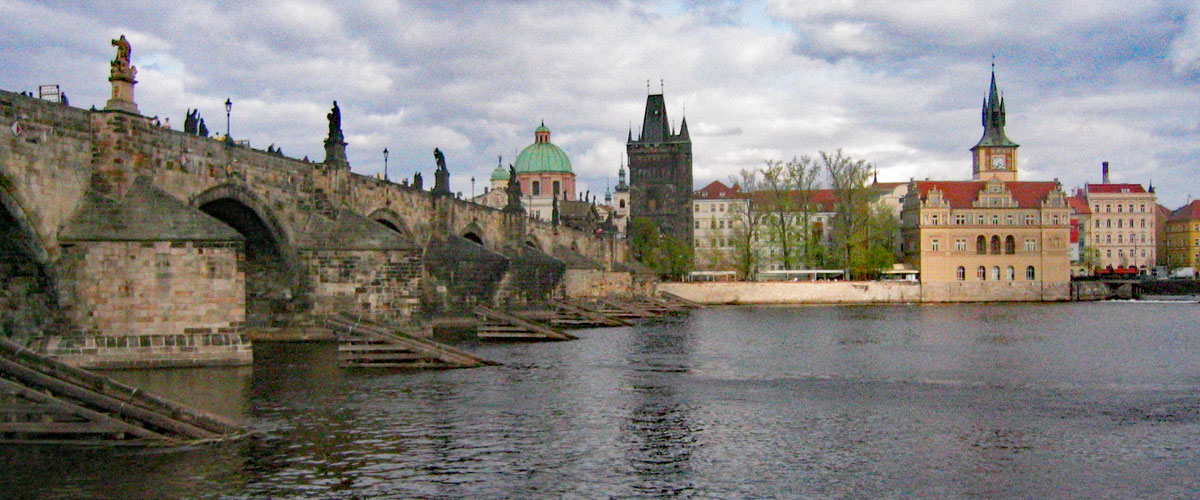
The pedestrian Charles Bridge — an iconic Prague landmark commissioned by King Charles IV — was built between 1357 and 1402 to replace the collapsed Judith Bridge. This Gothic stone arch bridge connects Prague's Old Town with its Lesser Town and was the only means of crossing the Vitava River until 1841. It was adorned with 30 Baroque statues of saints starting in the late 17th century.
View of the Charles Bridge from Lesser Town
Looking towards Lesser Town with St. Vitus Cathedral on the hill
More red tile roof tops
Each end of Charles Bridge is fortified by towers. The Old Town Bridge Tower is the gateway to Old Town and was also conceived as a symbolic victory arch through which Czech kings passed on their coronation processions. At the other end of the bridge are the Mala Strana (Lesser Town) Towers. The two towers do not match, as they were built 200 years apart. The smaller tower was part of the Judith Bridge before it was destroyed by floods in 1342 and the taller tower was constructed as part of the Charles Bridge.
The Old Town Bridge Tower at the entrance to Old Town
Pedestrians on the Charles Bridge
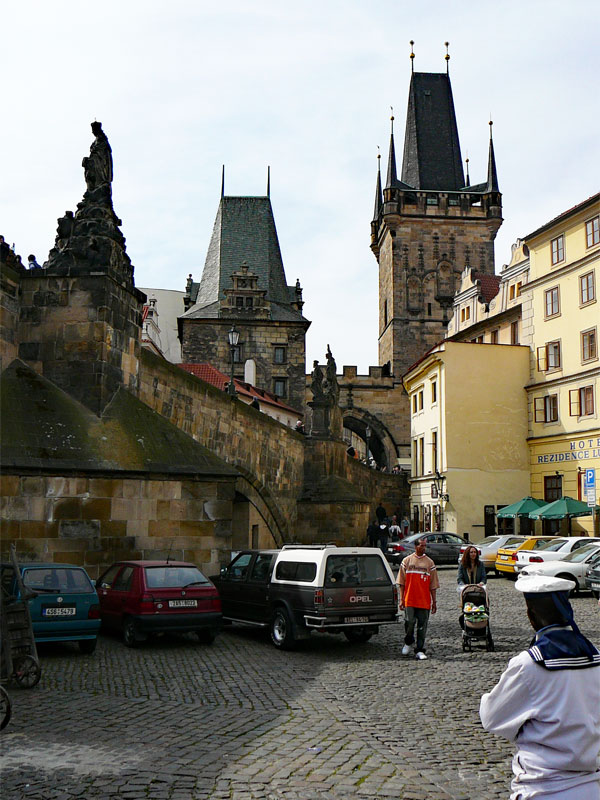
The Mala Strana Bridge Towers at the entrance to Lesser Town
Looking down the river from the Charles Bridge
Men with marionettes on the Charles Bridge
Lesser Town
Lesser Town, known as Mala Strana, is clustered around the foothills of Prague Castle. This district was founded in 1257 by King Ottokar II of Bohemia as the “New Town beneath the Prague Castle” and later became known as the “Lesser Town of Prague” in 1348, during the reign of Charles IV. Its Baroque palaces and churches were built after fires destroyed the district, once in 1419 and again in 1514.
View of the Charles Bridge from Old Town
Castle Quarter and Prague Castle
A short walk up the hill from Mala Strana is the Castle Quarter. Prague castle is one of the largest castle complex in the world with its 17 acre collection of royal palaces, churches, halls, courtyards and the magnificent St. Vitus Cathedral. Beyond the castle itself, there are many peaceful parks and beautiful lookouts.
Entering the Castle Quarter
View over Prague from the Castle Quarter
The St. Vitus Cathedral is the seat of the Archbishop of Prague and the largest and most important church in the country. It is also a prime example of Gothic architecture, with its intricate details, soaring arches, and stunning stained glass windows. The cathedral has a rich history dating back to the 10th century and has undergone numerous renovations and additions over the centuries. It is the final resting place of several patron saints, sovereigns, noblemen, and archbishops and has been the site of many important events, including coronations of Czech kings and queens.
St. Vitus Cathedral and some facade details
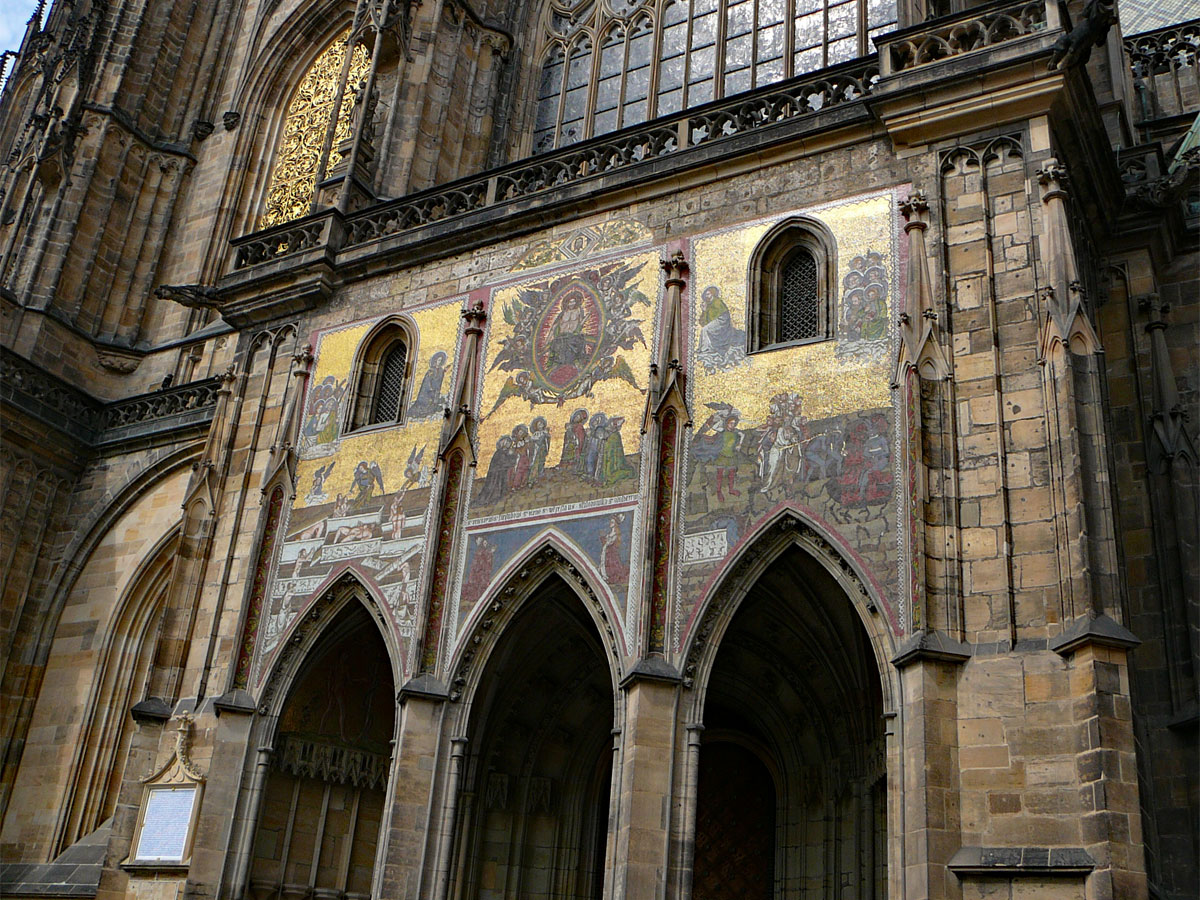
We were particularly impressed with the Golden Gate on the southern facade of St. Vitus Cathedral. This ceremonial facade, commissioned by Charles IV in 1370, is covered in a priceless mosaic depicting the Last Judgement.
Golden Gate entrance at St. Vitus Cathedral
Interior views of St. Vitis Cathedral
While at St. Vitus Cathedral, we climbed the 287 steps of the circular bell tower; at the top we were treated to wonderful views of the city.
Zikmund — the largest bell at St. Vitus Cathedral along with several other views over the city
View from the bell tower at St. Vitus Cathedral overlooking its rooster finial
St. George's Basilica — the oldest church in Prague
Neo-gothic Provost Residence
Schwarzenberg Palace with a Sgraffito facade creating an optical illusion
Beautiful view looking down the Vitava River
Walking back down to the river from the Castle Quarter
The End of Communism in Prague
The end of communism occurred in late 1989 with the Velvet Revolution, a non-violent uprising that saw the Communist Party of Czechoslovakia relinquish its power. Sparked by a student protest on November 17, 1989, the movement grew into mass demonstrations and a general strike, culminating in the collapse of the one-party state and the election of Vaclav Havel as president.
Statues and Monuments
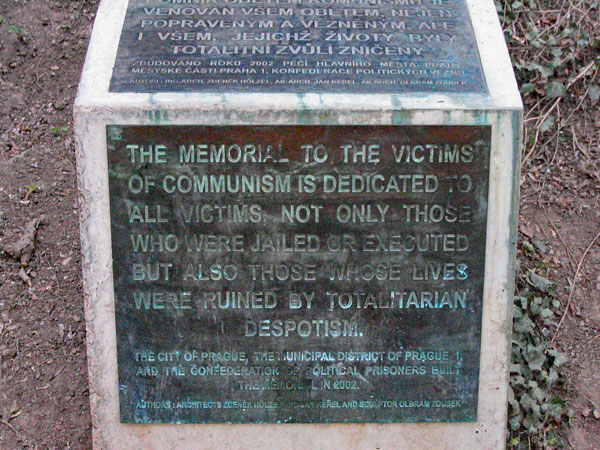
There are many historical and modern monuments and sculptures throughout the city. One of the most striking is the Memorial to the Victims of Communism which is a series of statues commemorating the victims of the communist regime in Czechoslovakia between 1948 and 1989. It is located at the base of Petrin hill in the Lesser Town area.
Memorial to the Victims of Communism
In addition to the 30 Baroque statues of saints alligning the Charles Bridge, at the center of the bridge there is a statue of St. John of Nepomuk, who was thrown off the bridge by Wenceslas IV for refusing to divulge the queen's confessions.
We were also impressed by the Cloak of Conscience, a rather creepy sculpture by Anna Chromy that sits outside the historic Estates Theatre. Although the faceless sculpture was created as a symbol for hope and peace, local residents believe it to be haunted.
Another imposing sculpture stands in Marian Square. Known as the Iron Knight, this artwork reflects the city's rich Gothic heritage and medieval folklore. The dark figure, standing tall and intimidating in full armor and wrapped in a twisted cape, could have inspired Darth Vader.
St. John of Nepomuk sculpture on the Charles Bridge
Cloak of Conscience sculpture by Ann Chromy
Iron Knight sculpture at Marion Square
In addition to public sculptures and statues, many of the buildings had beautiful ornamentation, signs, and other unexpected decoration.
Decoration at the entrance to the Atria Palace
Sign at the entrance to the Marionette Museum
An unexpected visitor on a building cornice
Postscript. Our visit to Prague was eight years after the end of communism in Czechoslovakia. Witnessing the transition from communism to capitalism was an interesting experience. While there was an exciting show of entrepreneurism, we often felt that as American tourists we were an obvious target. Having traveled a lot, we expected that restaurants in tourist areas would have higher prices on the English menu and this was certainly true in Prague. However, we were amused by some of our other experiences. For example, we observed an efficient network of street cars within the city but we could not find anyone at the hotel who could tell us how to buy tickets and secure a time schedule. The common response was to offer a us a private car and driver for hundreds of dollars a day! We ended up buying tickets at one of the local tobacco shops. With the internet now widely available and the rise of social media, this is most likely not a problem today.